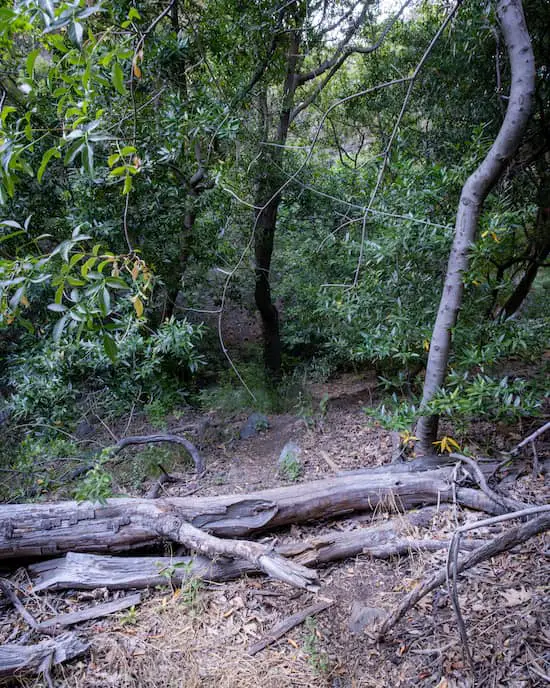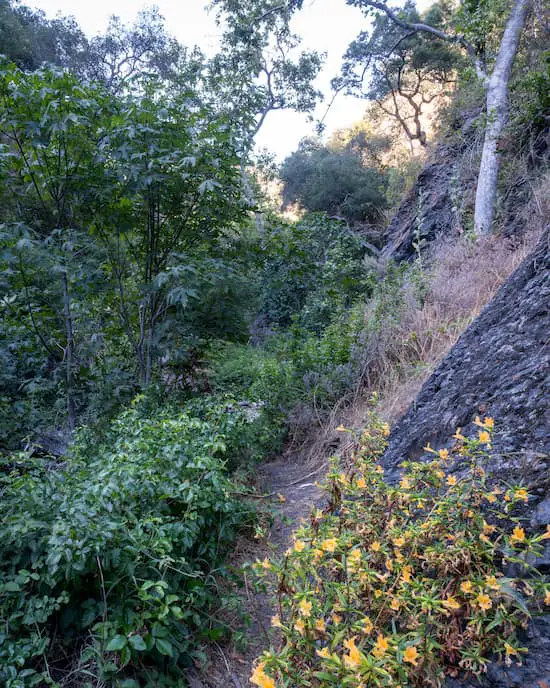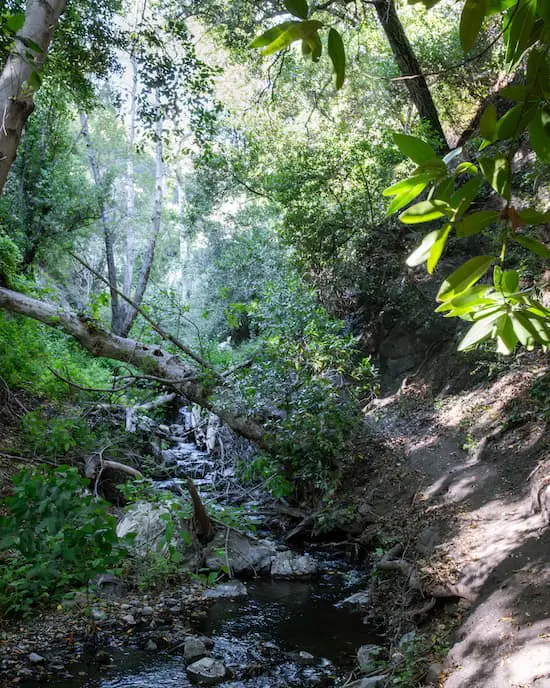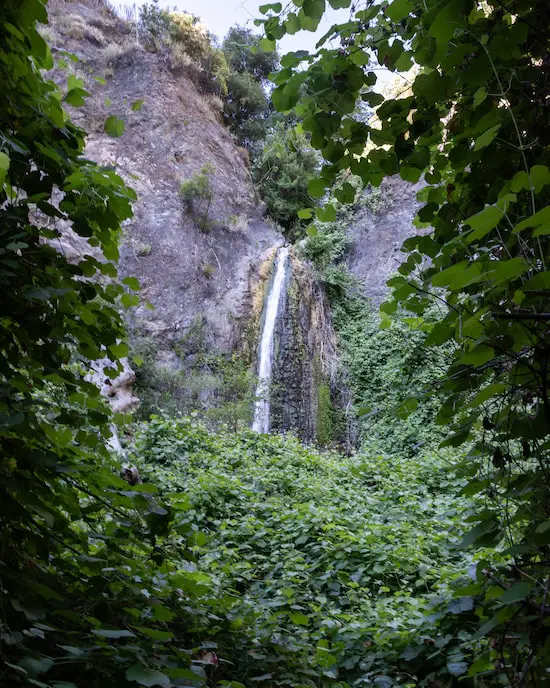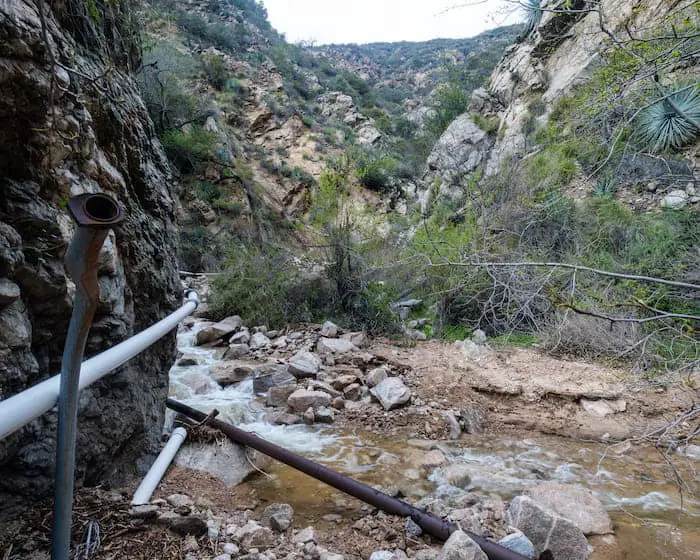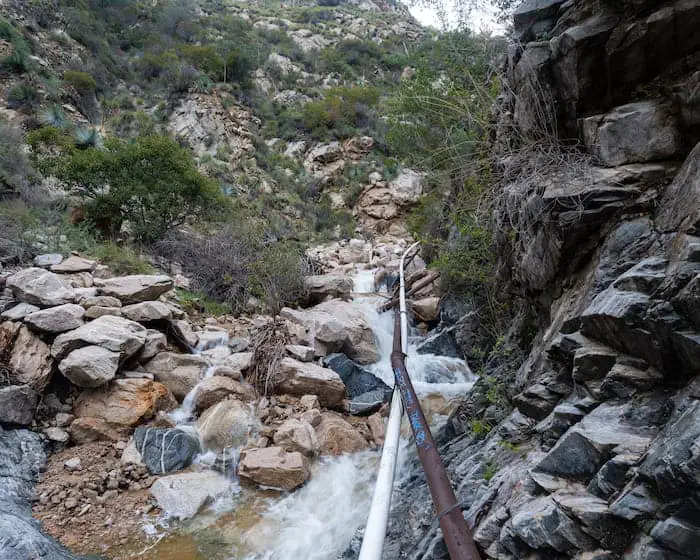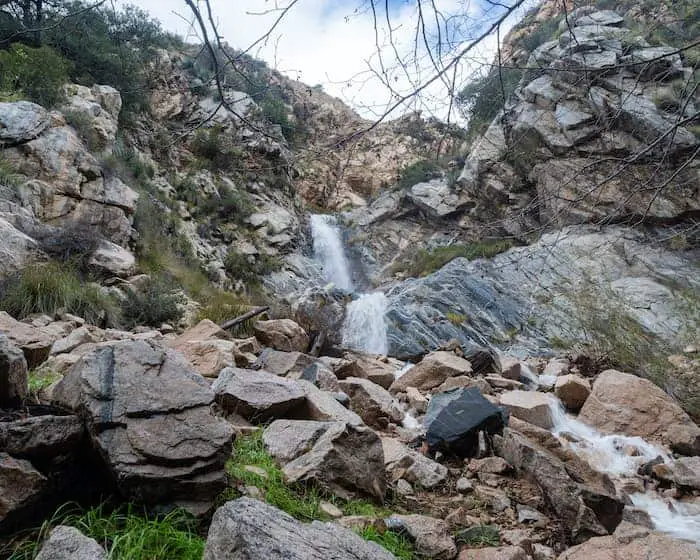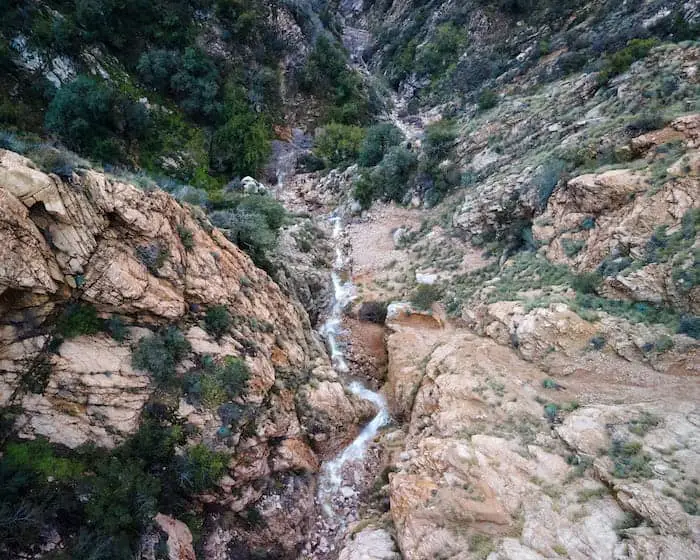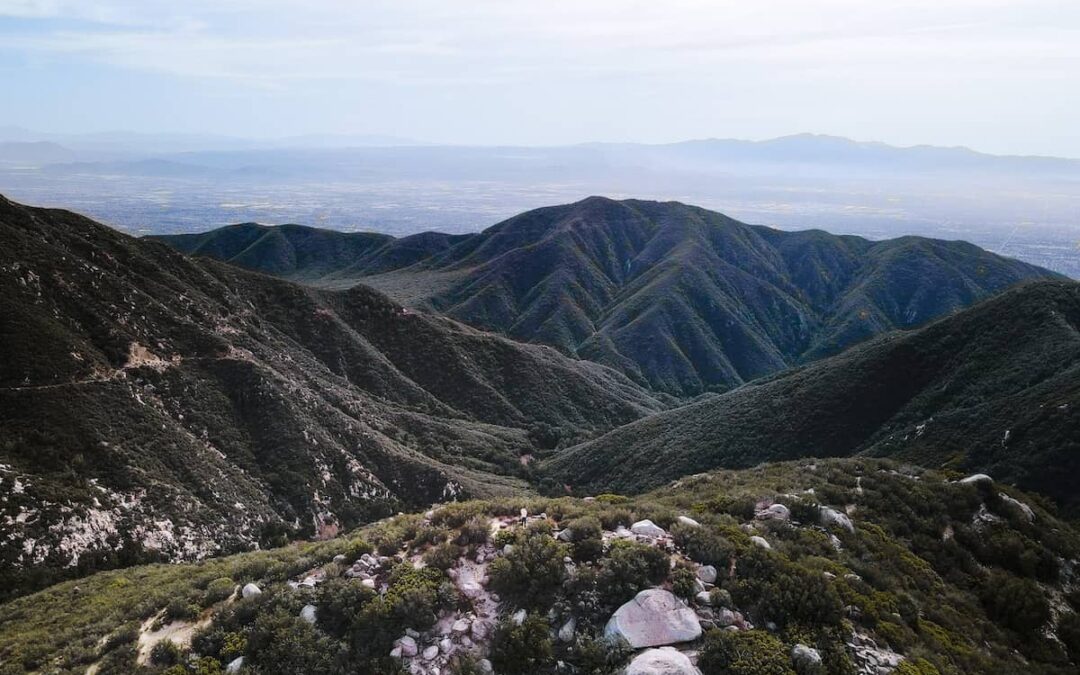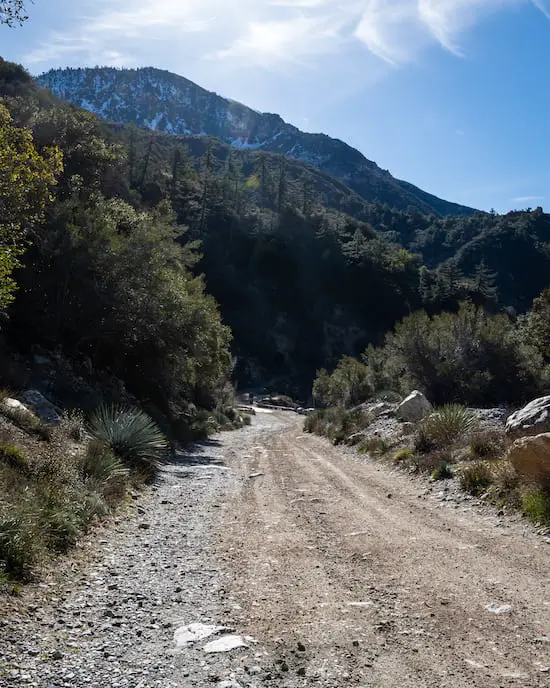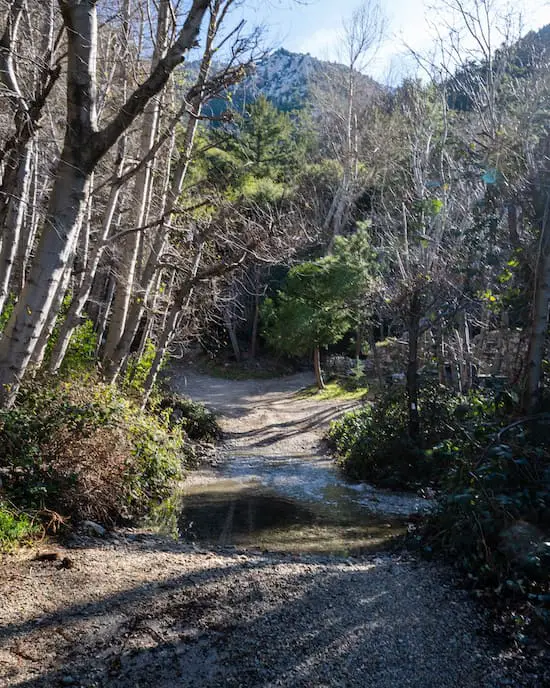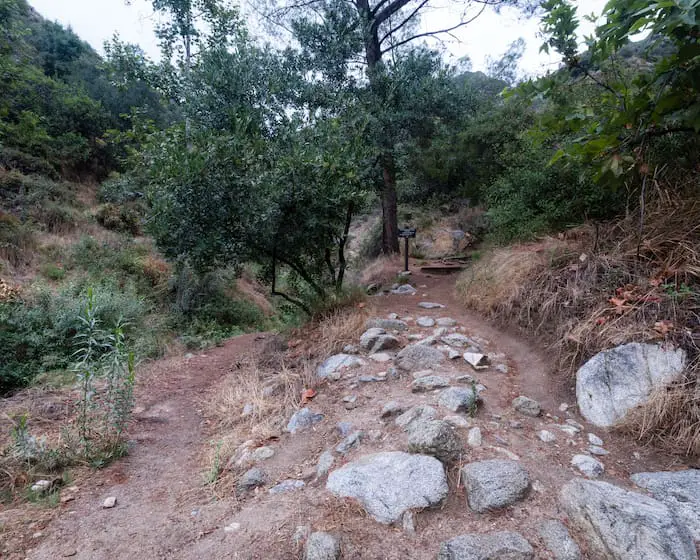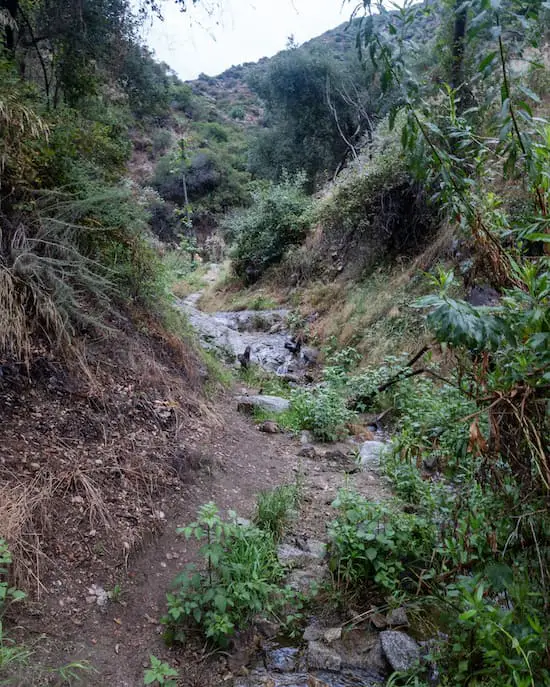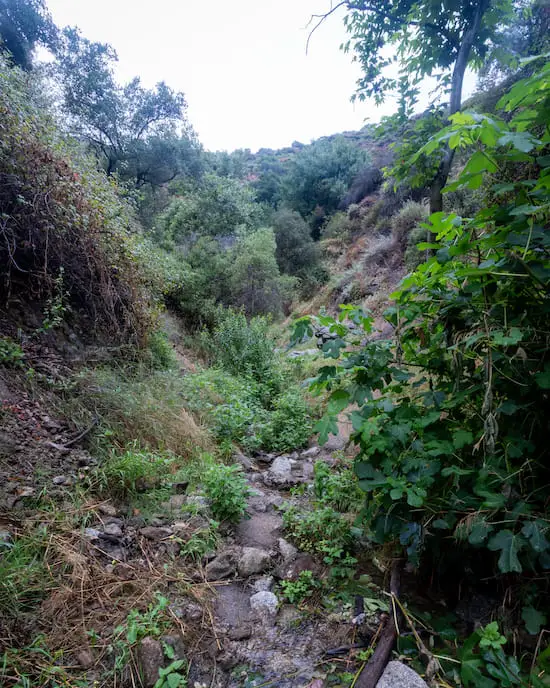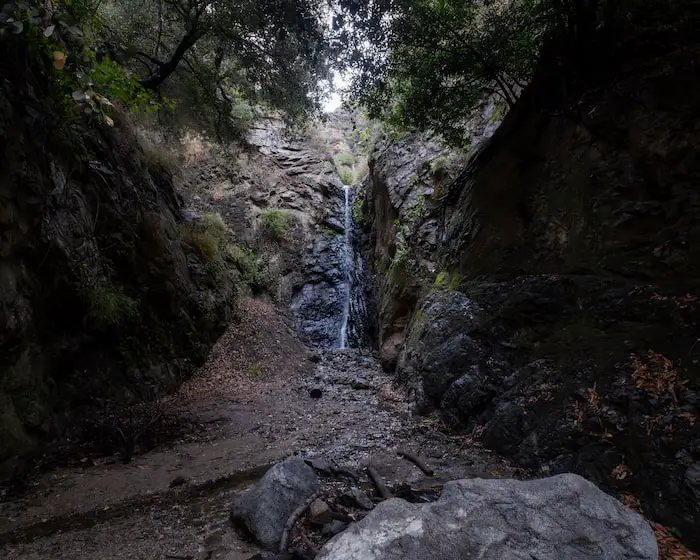
Holy Jim Falls: Plus Rarely Seen 2nd Larger Falls (Closed)

Holy Jim Falls: Plus Rarely Seen 2nd Larger Falls (Closed)

  • Miles: 3
  • Time: 1 Hour
  • Difficulty: Easy
  • Season: Late Spring
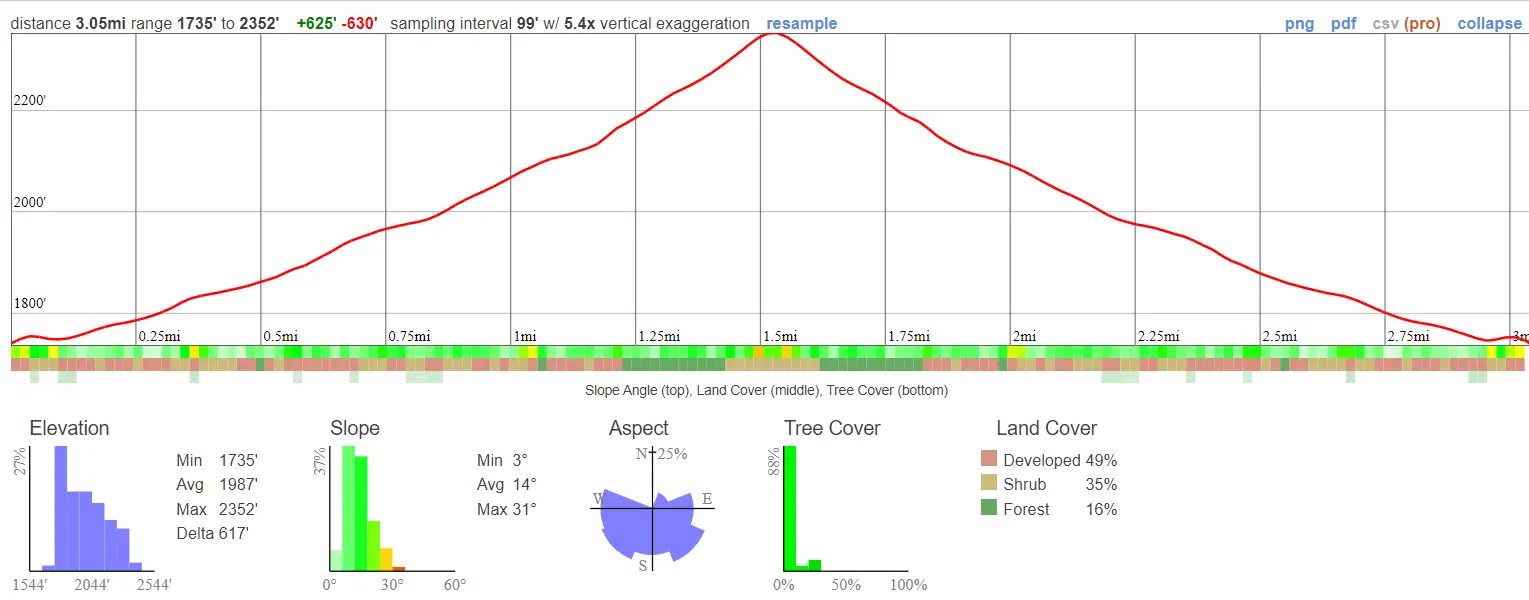
  • Elevation Gain: 617 ft
  • Max Elevation: 2352 ft
  • Trail Type: Out & Back
  • Parking Lot: Dirt Lot, Fits ≈ 20 Cars
  • Restrooms? 1 Porta Potty Available
  • Dogs Allowed? Yes, on a leash

What can possibly be better than hiking to a waterfall? How about over 4 miles of off-roading before you even get to the trailhead.

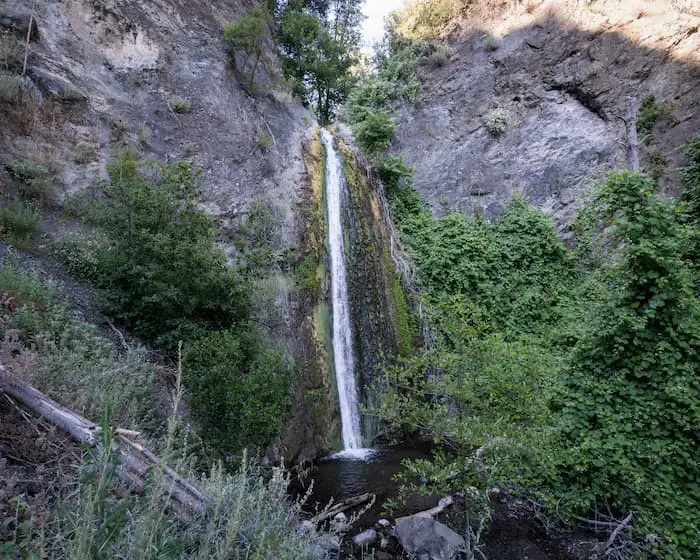
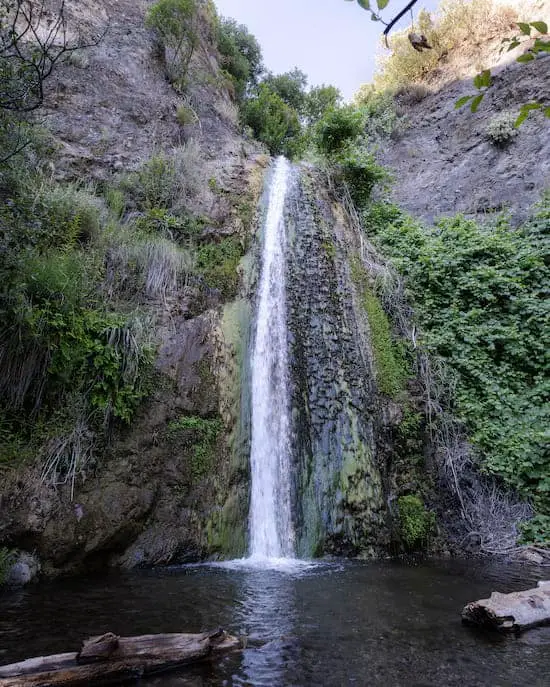
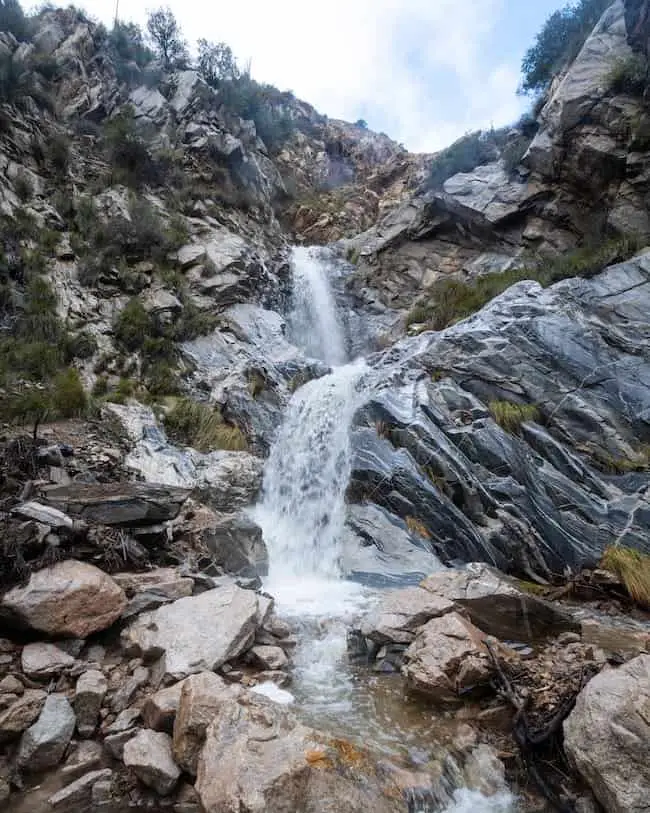
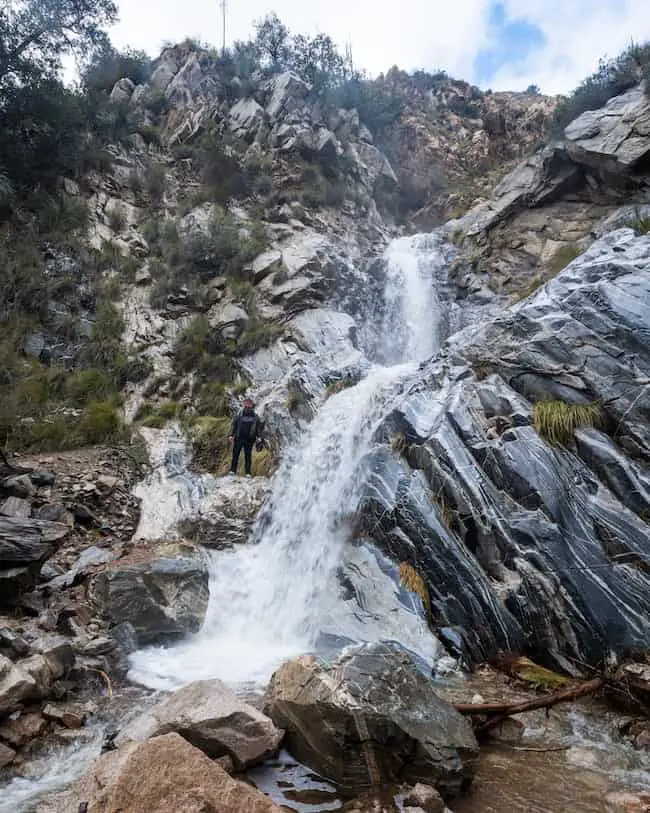
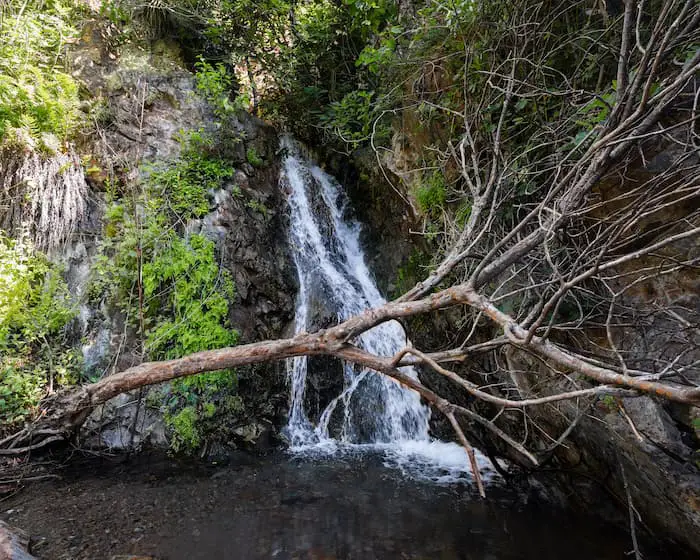
Holy Jim Falls is a roughly 20 foot waterfall named after the canyon it’s in, a tributary which connects to the much larger, Trabuco Canyon. The trail features abundant vegetation and multiple creek crossings, but is still easy enough for the whole family. Getting to the trailhead requires 4.6 miles of off-roading via Trabuco Creek Rd. Although 4×4 is not necessary, a high clearance vehicle is highly suggested.

Below is the beginning of the off-roading section.
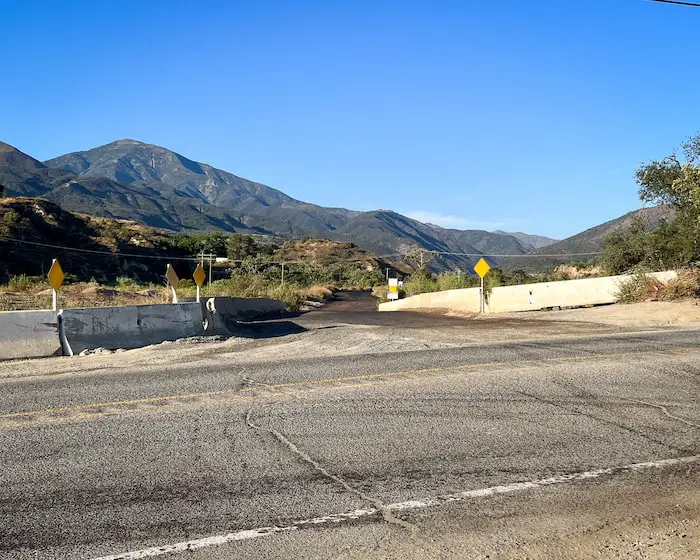
Beginning of Trabuco Canyon Road

For a complete list of hikes in Orange County, check out the following link:

Orange County Hikes

Fun Fact: There is another much larger and rarely-seen waterfall located further up the canyon, but thanks to my drone, I was able to take a few shots to share with you, so be sure to stick around until the end.

Trail Map
powered by Advanced iFrame

Holy Jim Trail Elevation Profile

Download Printable PDF Map

How To Get To Holy Jim Trail

To be redirected to the Holy Jim Falls parking lot via Google Maps, click the link here.

The parking lot is located at the intersection of Holy Jim Canyon Rd & Trabuco Canyon Rd. From there, you’ll have to hike up Holy Jim Rd (multiple private homes are located here so please be respectful) for a few minutes, to reach the actual trailhead.

Holy Jim Falls Trail

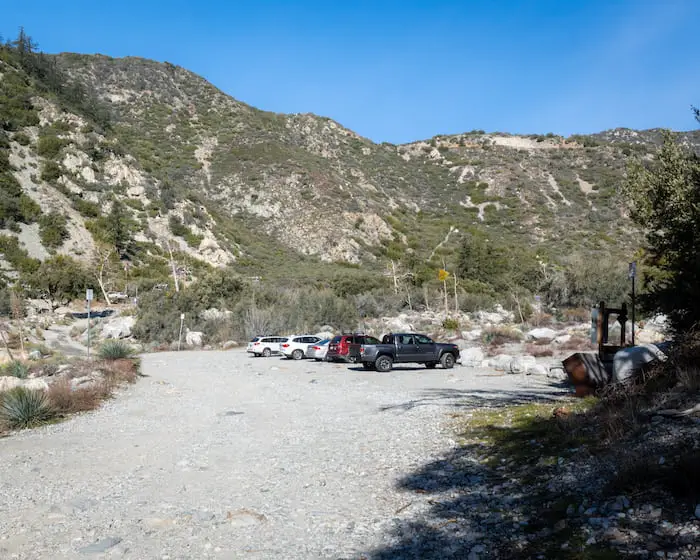
Two different roads split off from the dirt parking lot, so be sure to hike up the road to the left.

Although the locals placed a road block to prevent vehicles from accessing the road, all hikers were welcomed on foot.
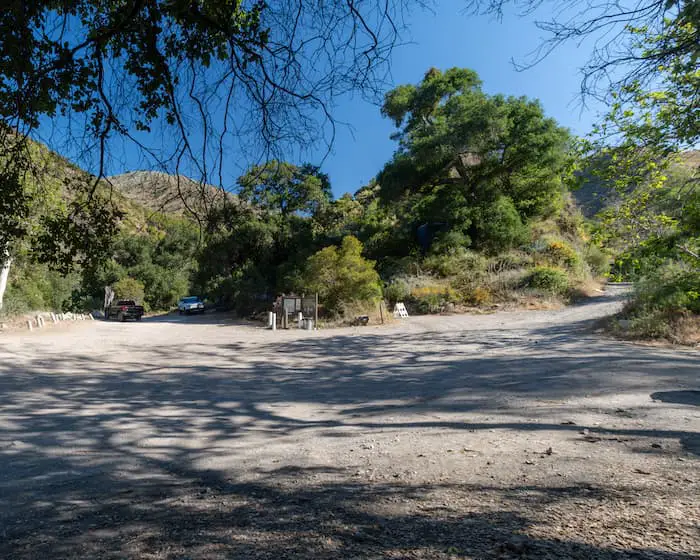
Holy Jim Falls Parking Lot

Want to explore a sandstone cave that was once used as a hideout for bandits? Check out The Dripping Cave Trail in Laguna Beach.

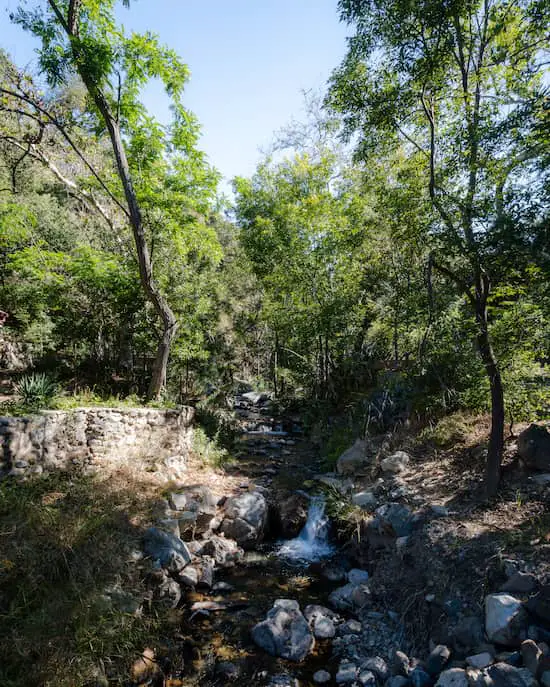
Private cabins marked the landscape while bridges with amazing creek views and small waterfalls made me feel like I was in heaven.
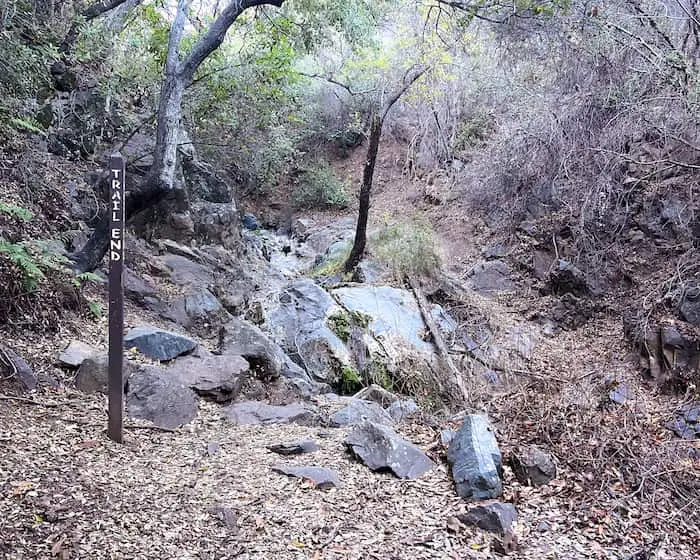
Once the road ended, the actual trail, which was marked by a sign, began.

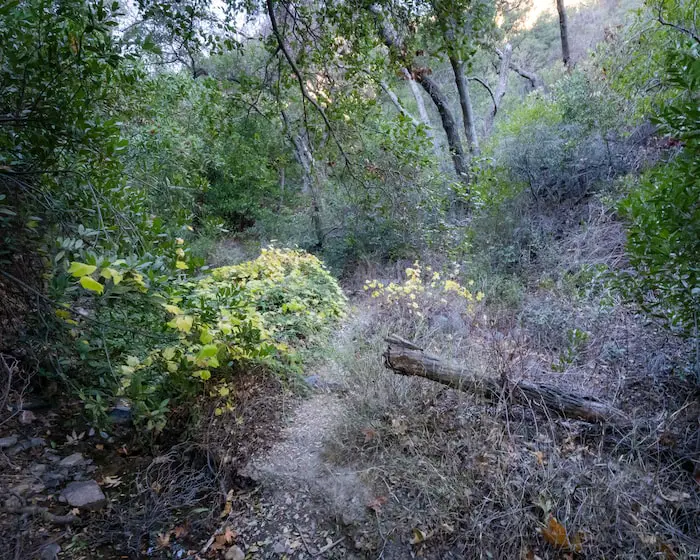
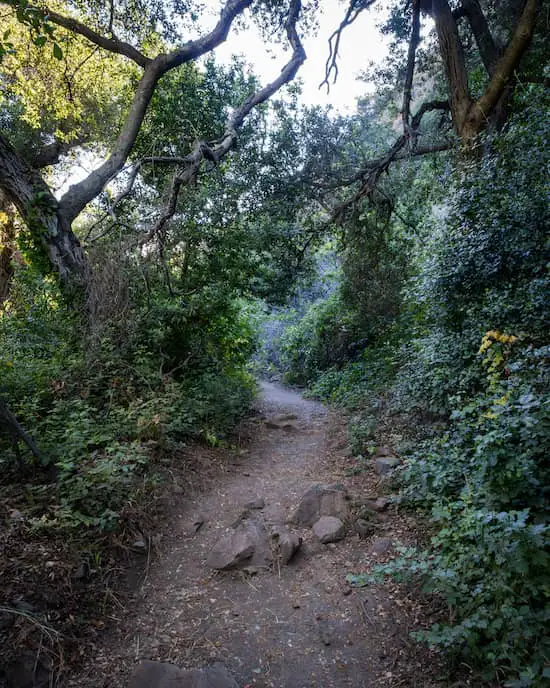
The scenery immediately transformed into a luscious, green-filled vegetation with abundant shade.
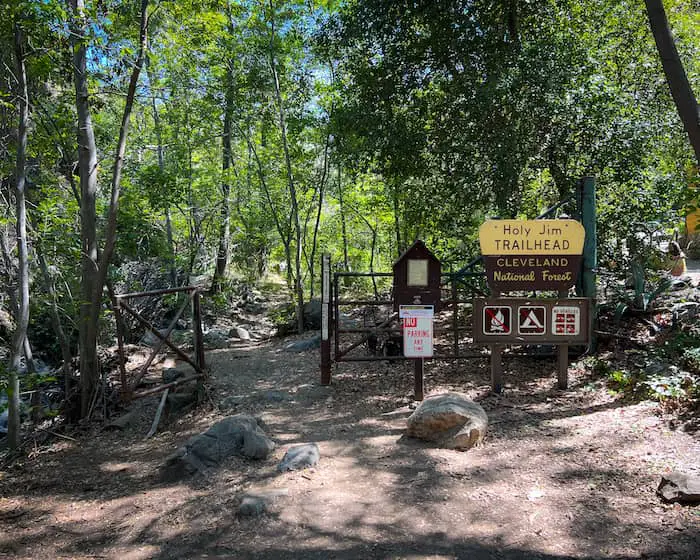
Holy Jim Trailhead

Immediately after walking through the trailhead gate, I came face to face with my first obstacle, a creek crossing.

Fortunately, all creek crossings on this hike are fairly easy and doable by beginners.
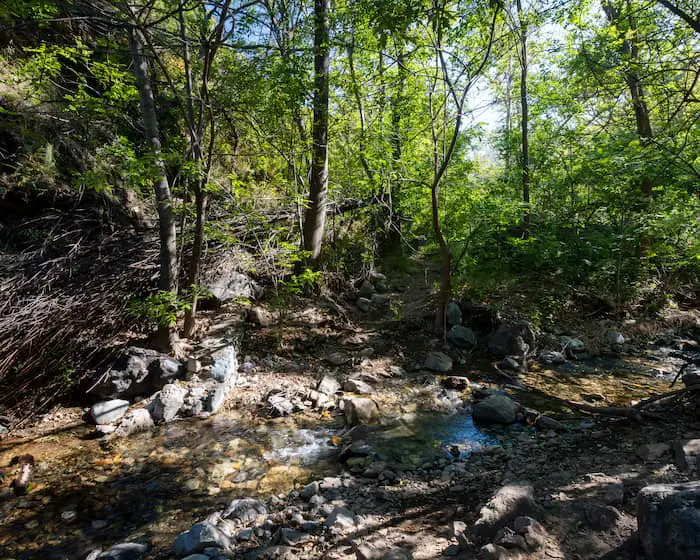
Creek crossing on Holy Jim Trail

Since I visited in the spring time, vibrant wildflowers decorated trail.

I’m not an expert in mountain flora (yet), but thanks to the app Picture This, which I forgot to use, you can identify all sorts of flowers and trees.
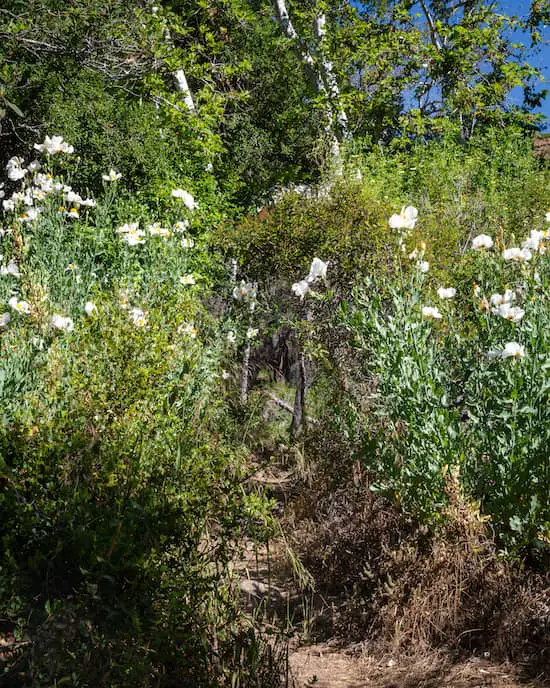
One very popular SoCal tree which I did recognize, however, is the live oak tree.

These trees were abundantly found throughout the Holy Jim Trail, and, in this particular case, were adorned by the invasive Hedera Helix Ivy.
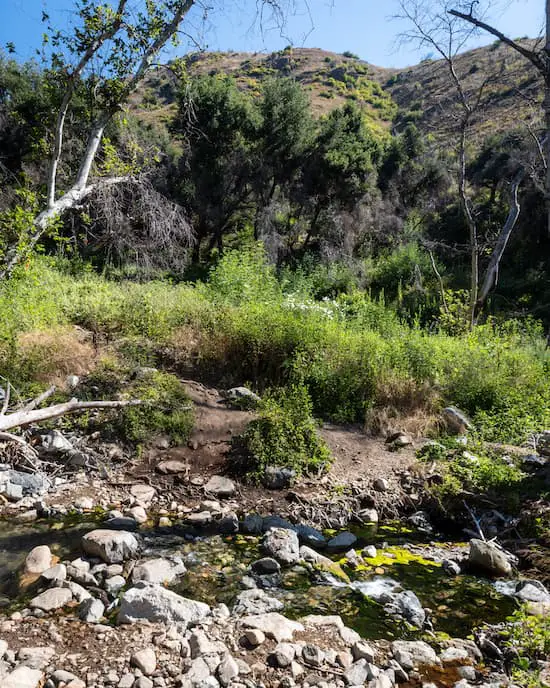
Although much of the trail was shaded, a few sections came to an opening in the forest canopy, and the views didn’t disappoint.

Beautiful mountain ranges surrounded the trail as the moss-covered creek weaved its way through the canyon floor, making me feel like I was hiking deep in the mountains.
Looking for more hikes with amazing views? Check out the Top Of The World in Laguna Beach, arguably the most popular trail in Orange County.

Shortly thereafter, the trail made its way back underneath the trees, and then…
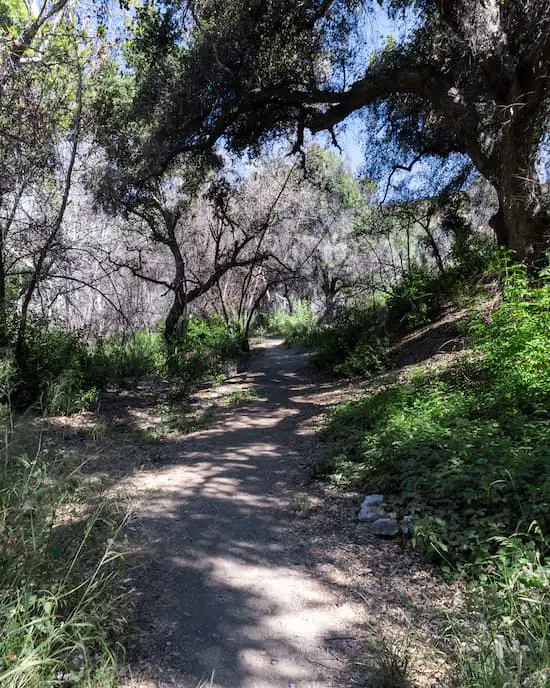
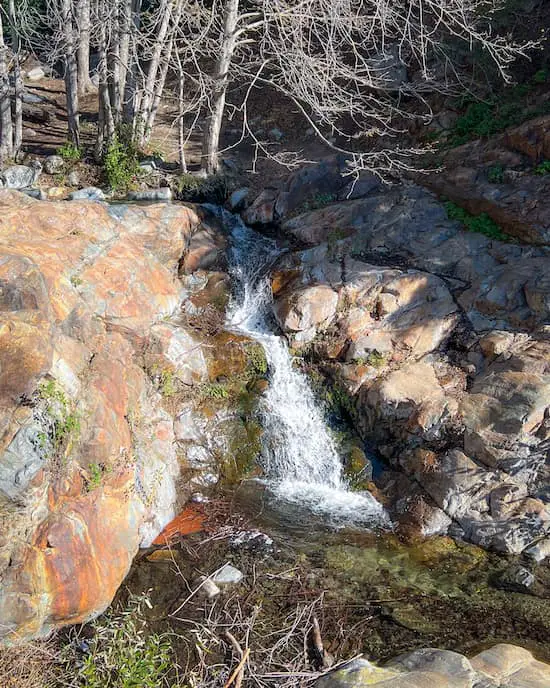
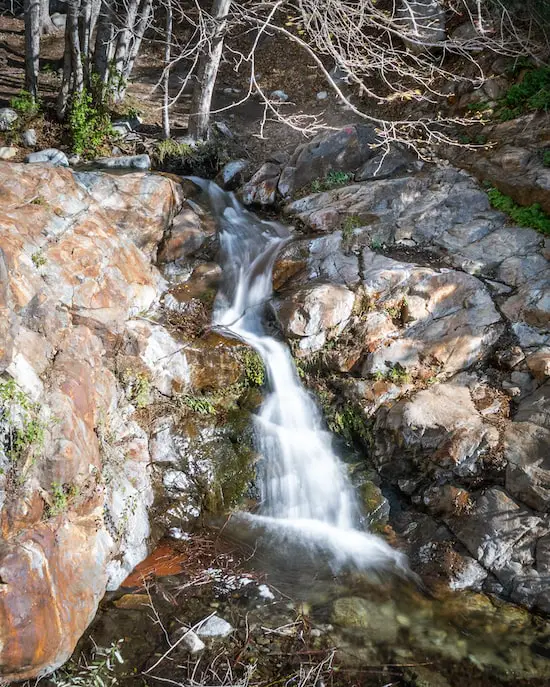
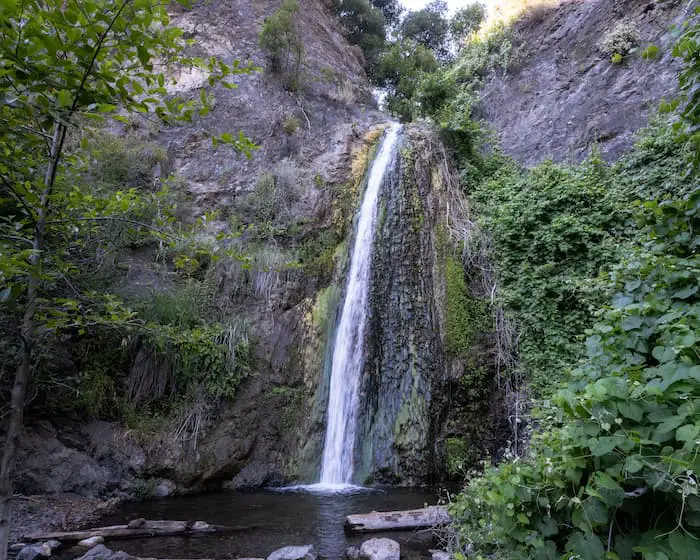
The waterfall came into view.
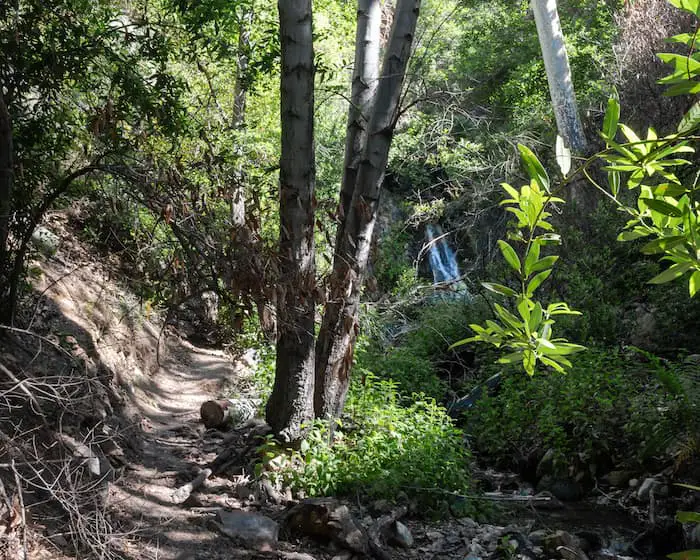
I was so grateful to see Holy Jim Falls flowing, as it’s quite rare.
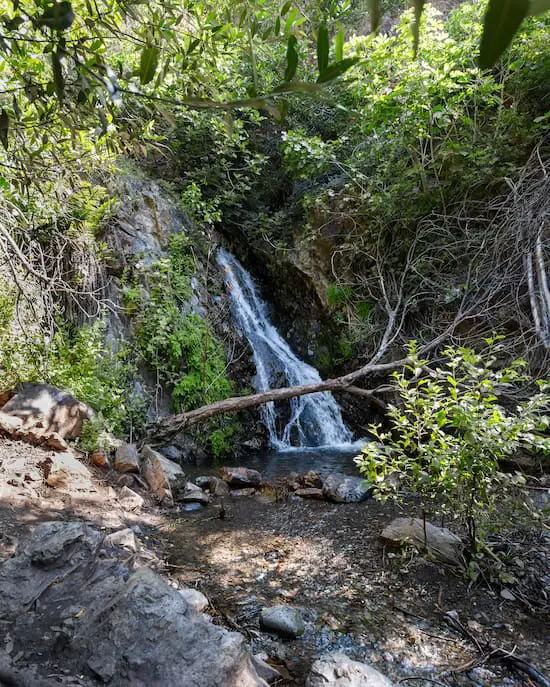
Holy Jim Falls Trail

The falls is pretty small compared to most other waterfalls, but definitely still worth a visit.

I visited the falls twice. Once on a Sunday, and the other during the week.

I had the place to myself during the week, but that was far from the case when I visited on Sunday. Be prepared for small crowds during weekends.
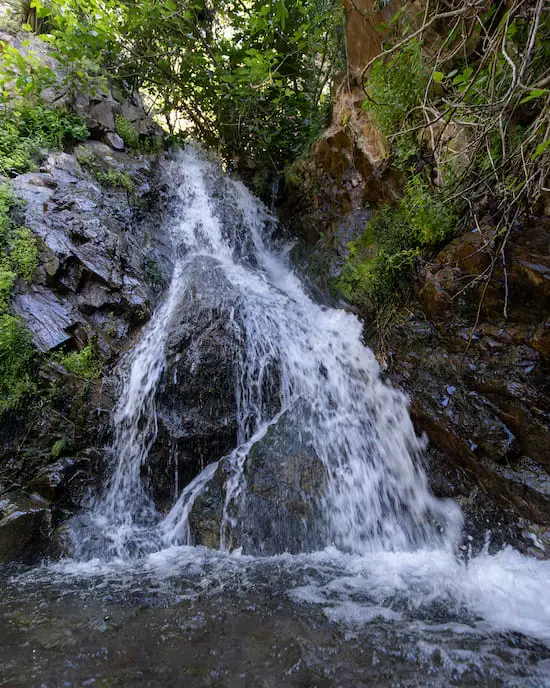
Holy Jim Falls Trail

I loved how there was so much greenery surrounding the falls. You can never have too much vegetation.

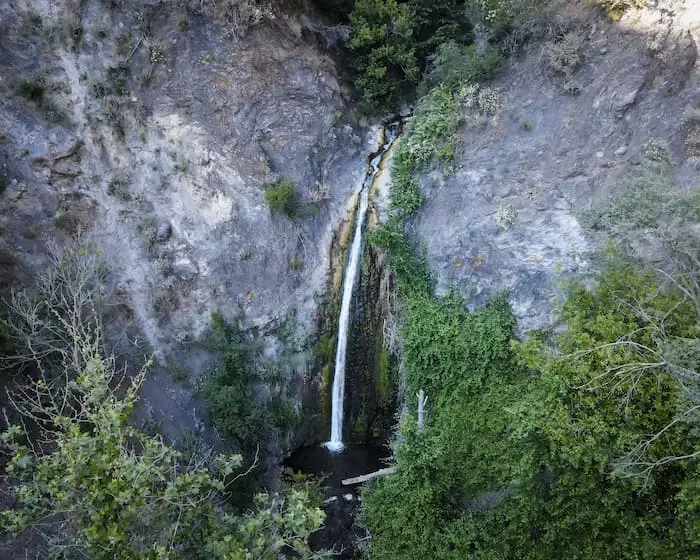
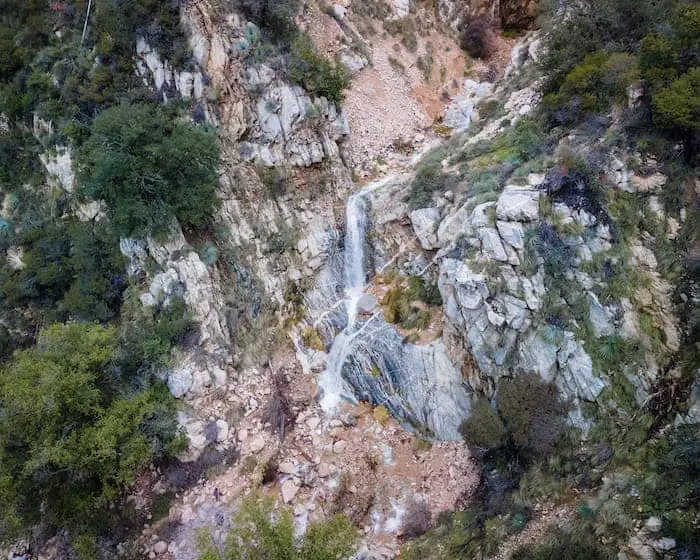
If you follow my journey throughout our SoCal mountains, you know I always fly the drone when I get to the falls.

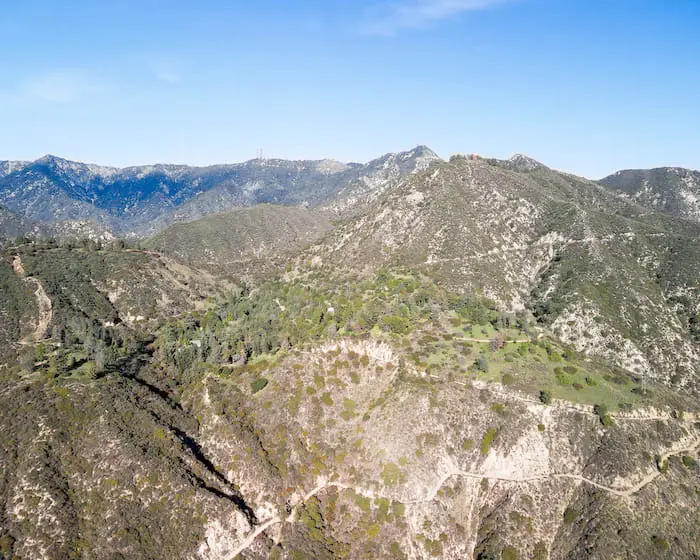
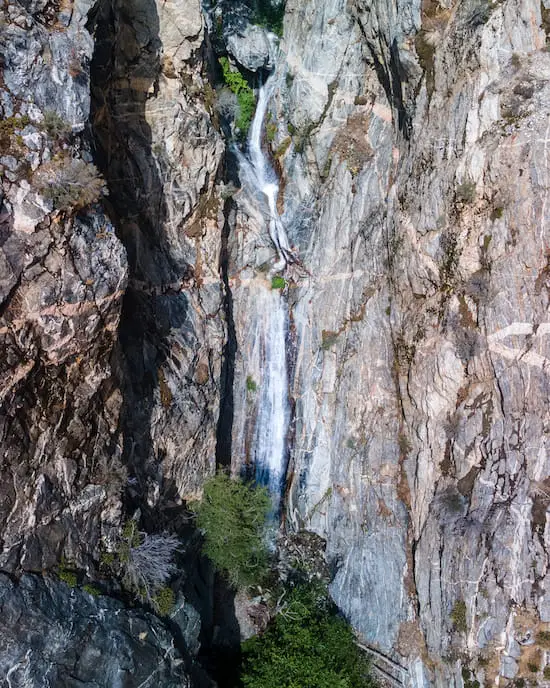
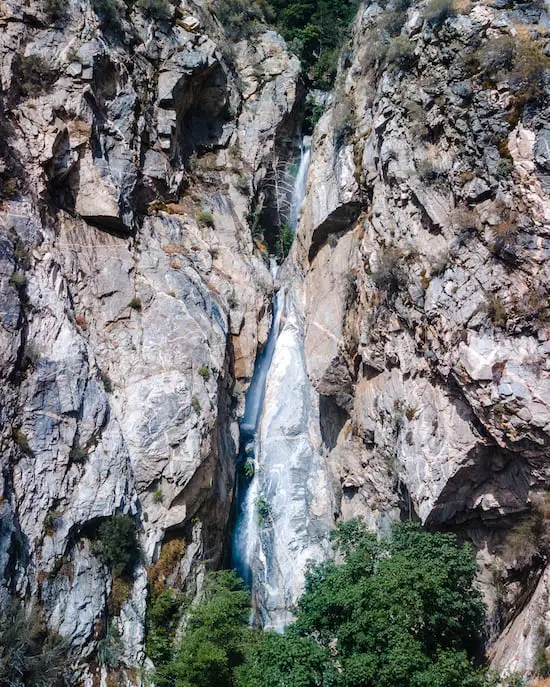
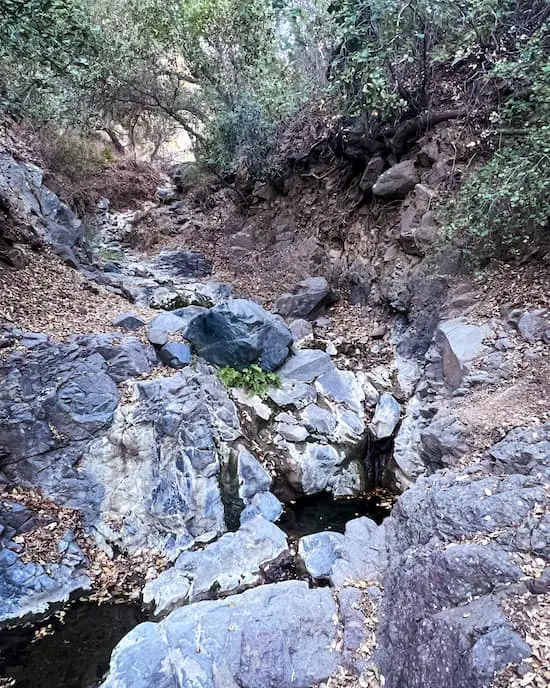
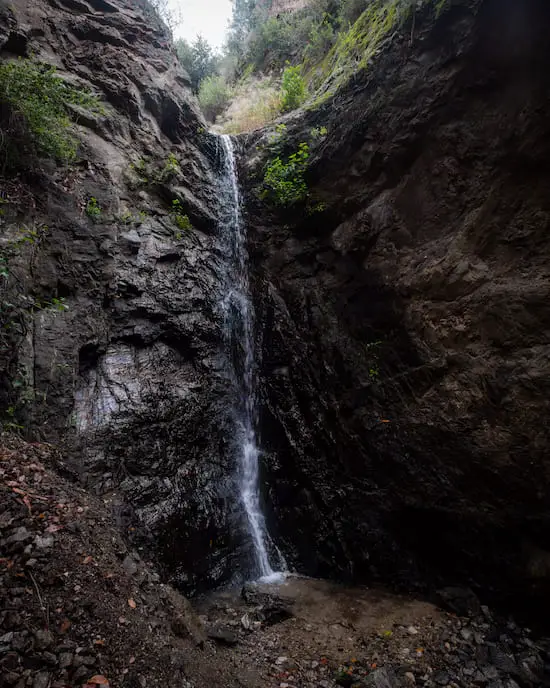
To my very pleasant surprise, I found an even larger flowing waterfall further up the creek.

I believe this waterfall may be what I’ve seen referred to as Upper Holy Jim Falls. I haven’t figured out exactly how to get to it, but that’s going to be an adventure for another day.
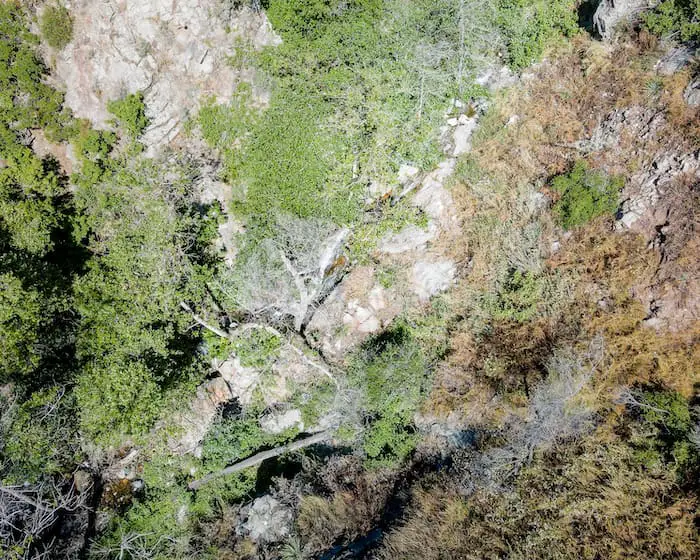
Upper Holy Jim Falls

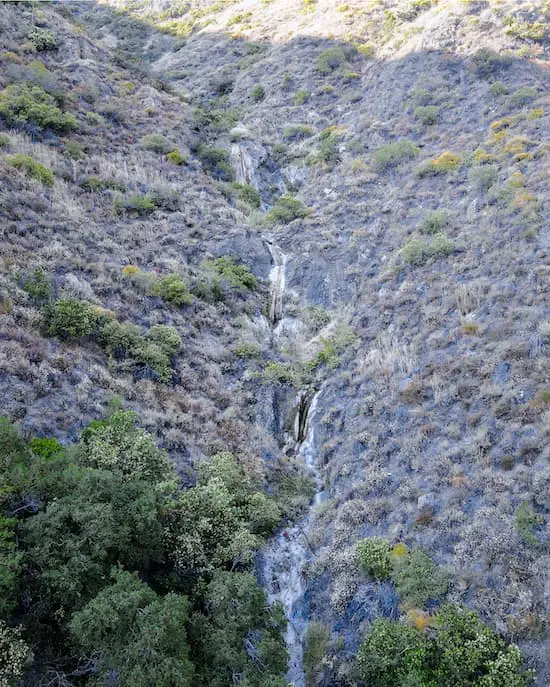
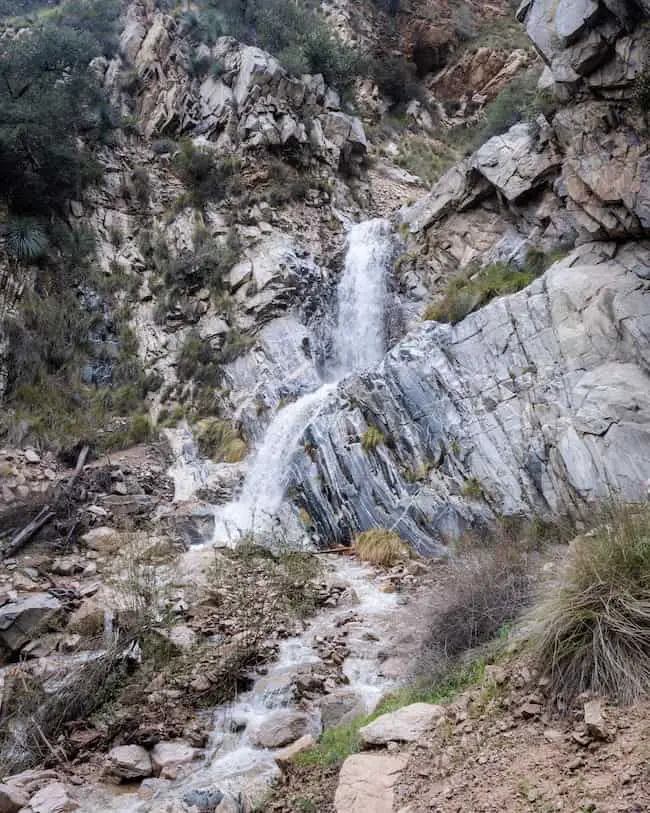
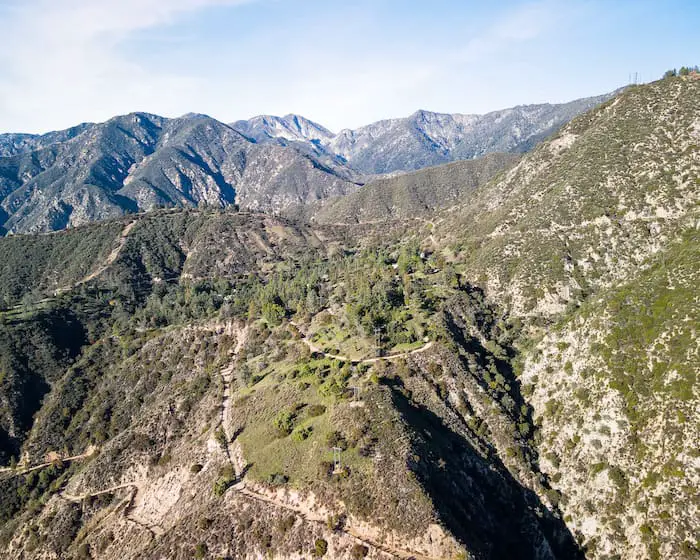
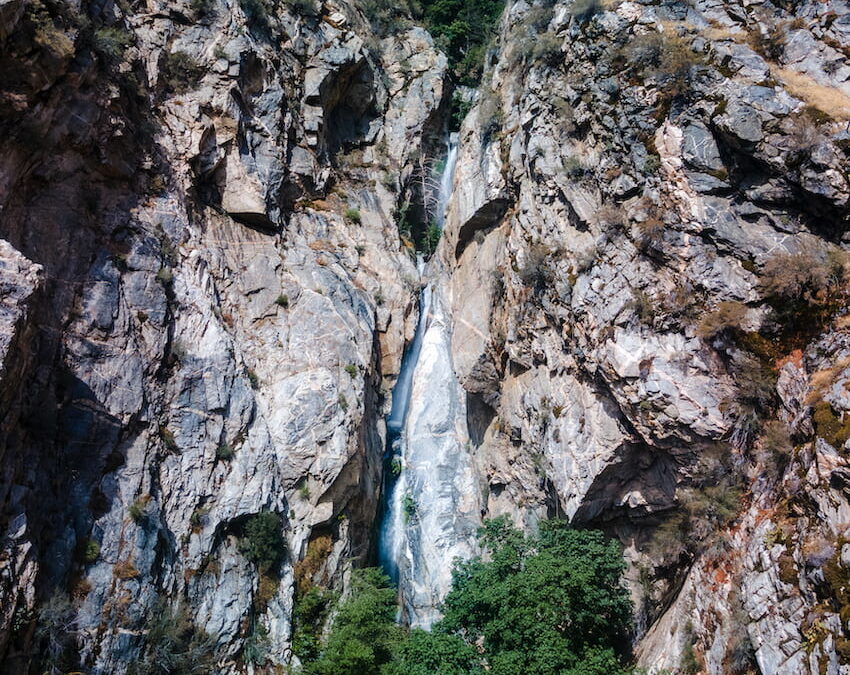
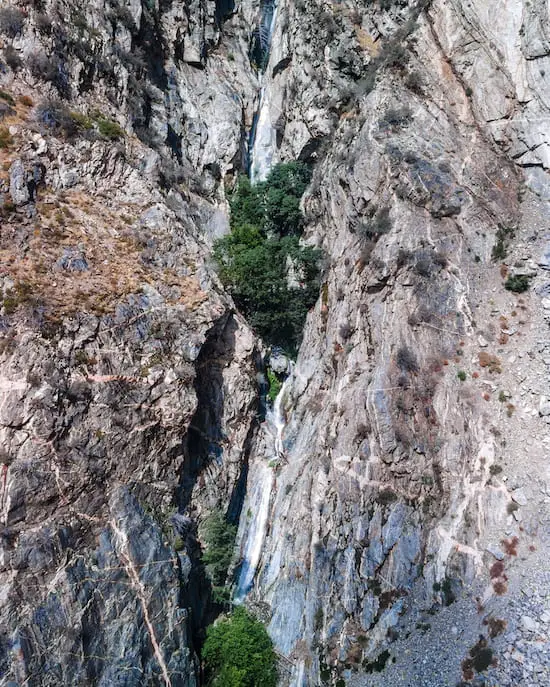
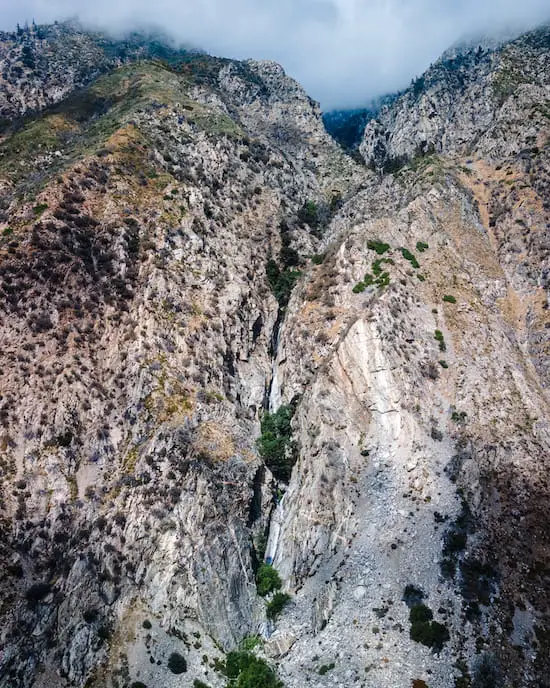
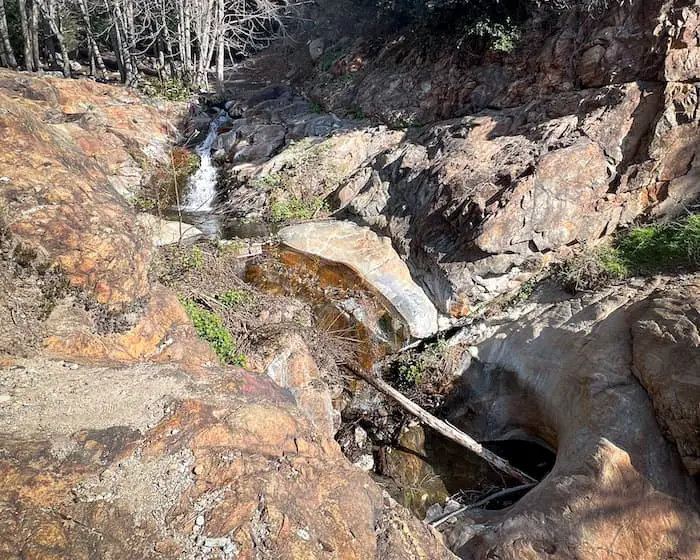
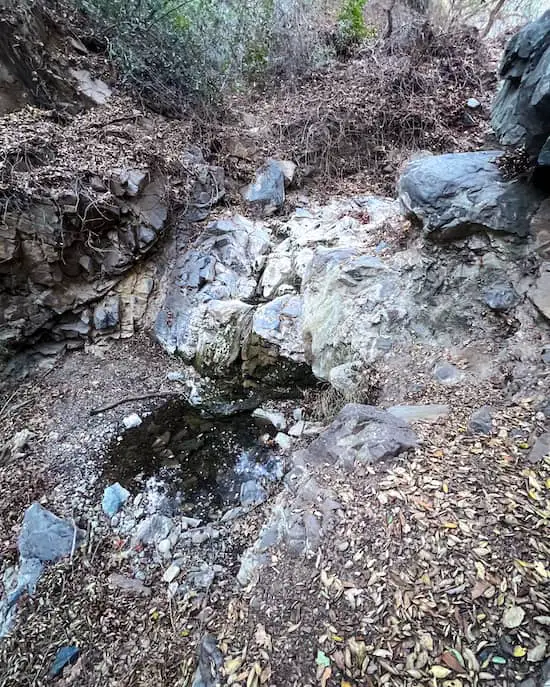
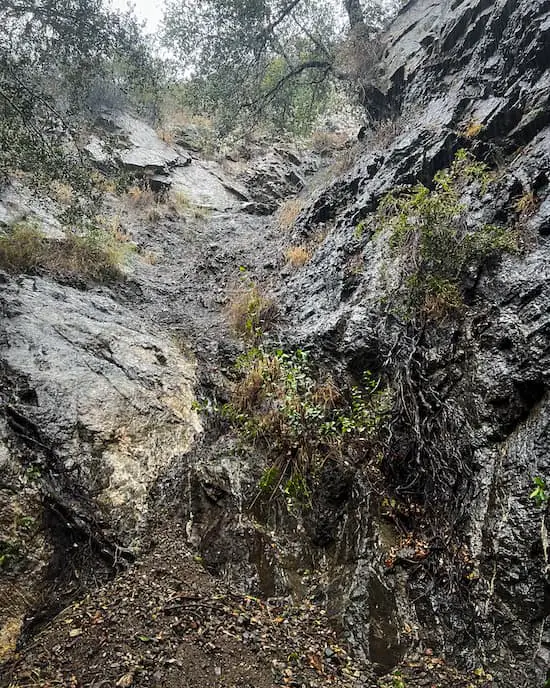
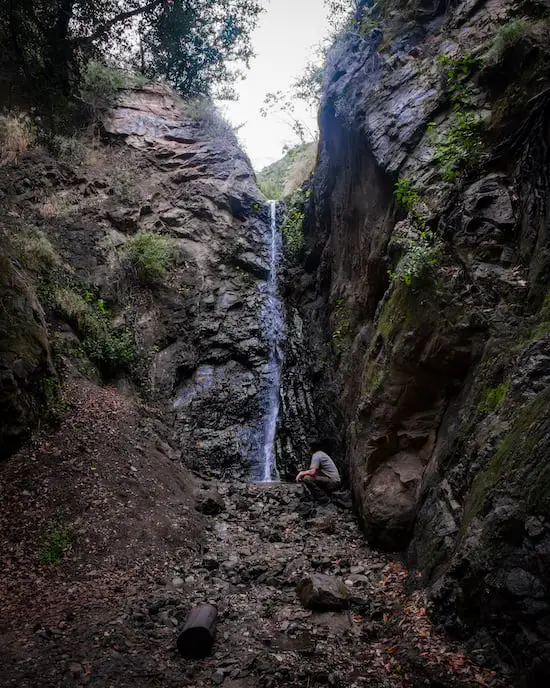
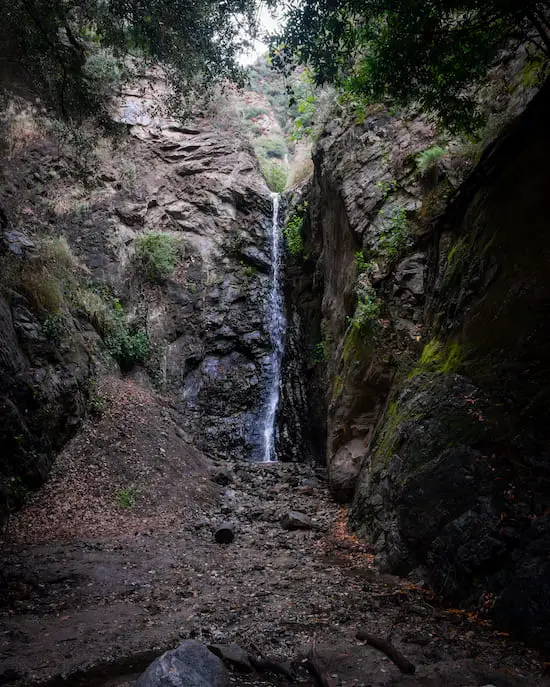
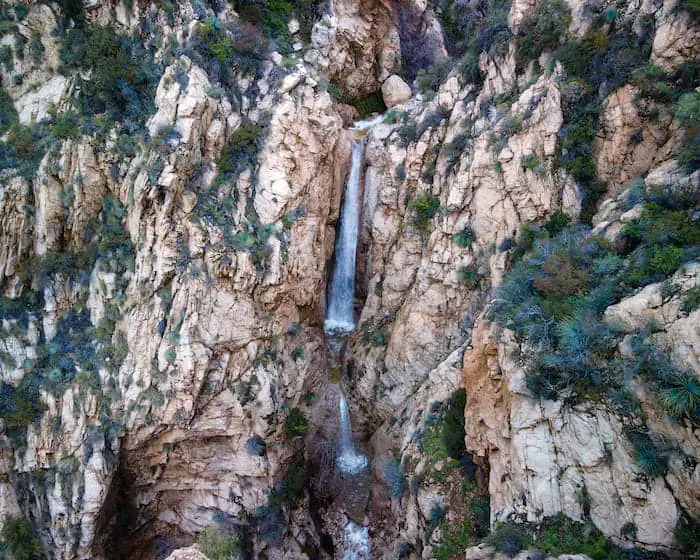
But wait, there’s more! I flew the drone over a nearby tributary, and found yet another large waterfall.

This one was much more dry as it was located in a different creek, but, at one point earlier in the year, it must have been flowing just as nicely as Holy Jim Falls.
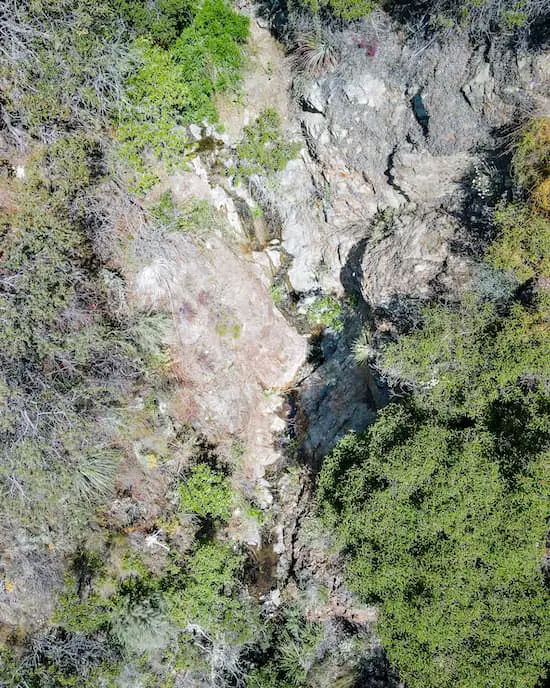
The adventure doesn’t have to come to an end. Click the following link to be redirected to the three best hikes in Laguna Beach.

FAQ

Is Holy Jim Falls Open?

This trail is now open to the public, at least as of June 2023 when I personally hiked to the falls.

How Long Does It Take To Get To Holly Jim Falls?

It takes about 45 minutes to 1 hour to get to the waterfall.

How High Is Holy Jim Falls?

Holy Jim Falls is roughly 20 feet high, give or take 5 feet.
Falls Canyon Falls (Trabuco Cyn) & 2nd Never Seen Waterfall

Falls Canyon Falls (Trabuco Cyn) & 2nd Never Seen Waterfall

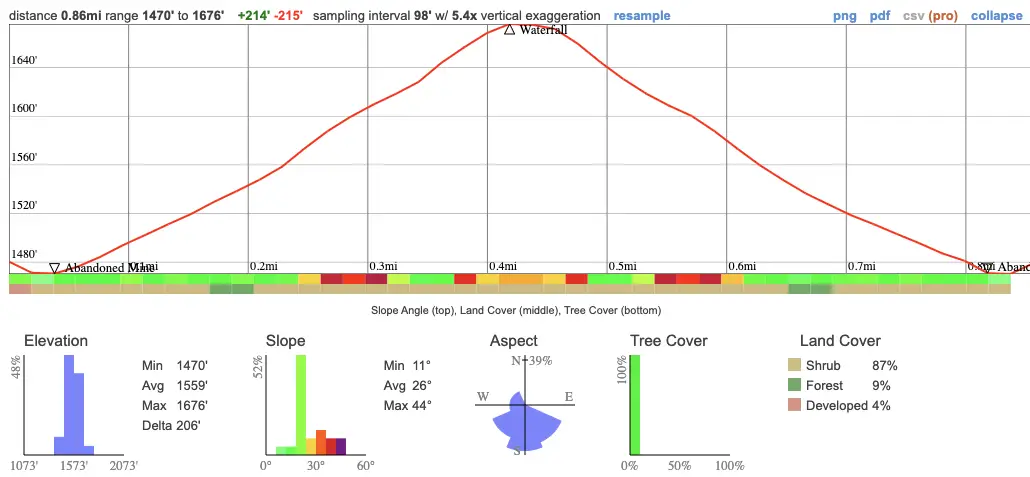
  • Miles: 0.86 Roundtrip
  • Time: 45 minutes Roundtrip
  • Difficulty: Easy
  • Season: Spring
  • Elevation Gain: 214 ft
  • Max Elevation: 1676 ft
  • Trail Type: Out & Back
  • Parking Lot: Turn Out, Fits ≈ 2-3 Cars
  • Restrooms? Not Available
  • Dogs Allowed? Yes, on a leash

Falls Canyon Falls, a tributary of the well-known Trabuco Canyon and therefore incorrectly referred to as Trabuco Canyon Falls, is a secret waterfall located in Orange County.

This easy hike requires about 3.5 miles of off-roading just to get to the trailhead. A 4×4 vehicle is not required, but high clearance is highly suggested. The hike features an abandoned mine right from the start. Since poison oak and bugs are abundant, long sleeves and pants are recommended. At roughly 50 feet tall, Falls Canyon Falls is a sight to see. Although the waterfall rarely flows, the wet winter of 2022-2023 has kept this waterfall flowing nicely late into the year, and will probably not dry up until late August.

During my visit, I flew the drone over the falls as I usually do, and was pleasantly surprised. Not much further up the tributary was another enormous, 5-tier cascade, which I’ll be happy to share with you in this post.

Please remember to tag responsibly if you decide to share on social media. Failure to do so always leads to trash, graffiti, and the destruction of these beautiful paces. 

Falls Canyon Falls Map

powered by Advanced iFrame

Falls Canyon Falls Elevation Profile

Download Printable PDF Map

Falls Canyon Falls Directions

Click the link to be redirected to Fall Canyon Falls trailhead via Google Maps.

There is no parking lot for this trail. You’ll have to park off the side of the dirt road either further up or before the trailhead.

Are you looking for hikes in Orange County? Check out the complete list of OC hikes by clicking the link below!

Orange County Hikes

Falls Canyon Falls Trail

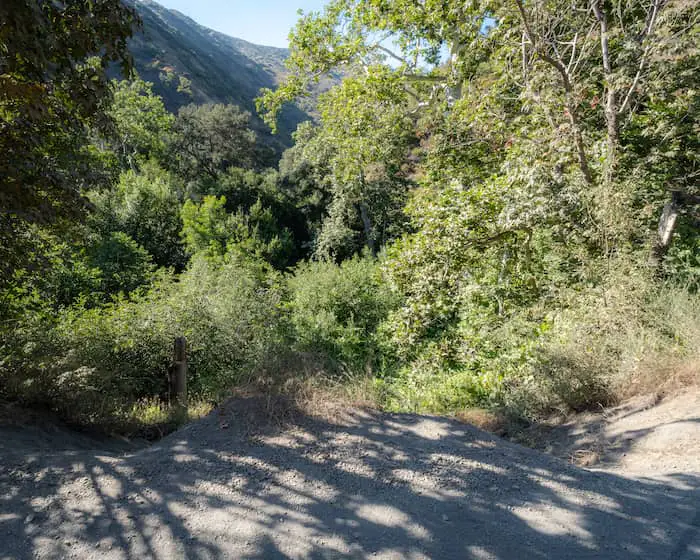
The trailhead is located on the left side of the trail. Look for two dirt trails that quickly merge into one.

Falls Canyon Falls Trailhead

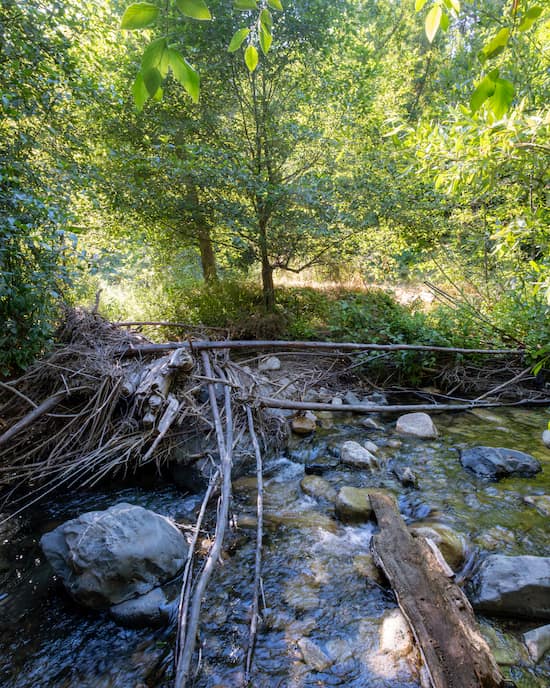
Almost immediately after the two trails merged, I had my first obstacle, crossing Trabuco Creek.

Falls Canyon Falls Trail

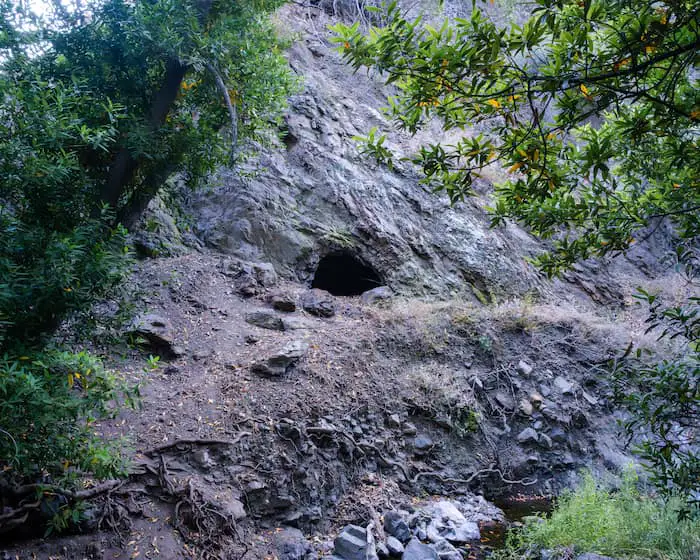
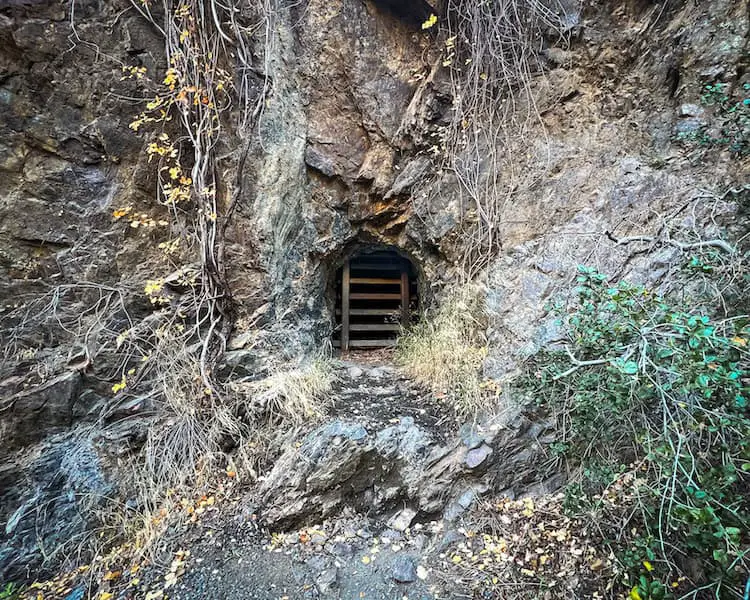
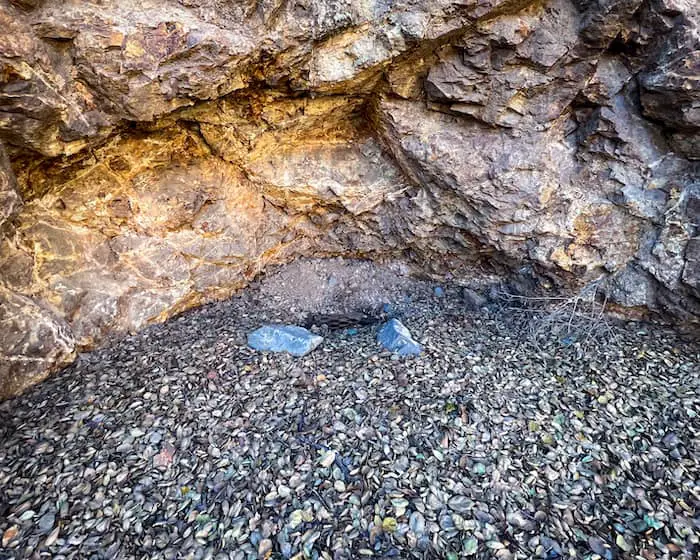
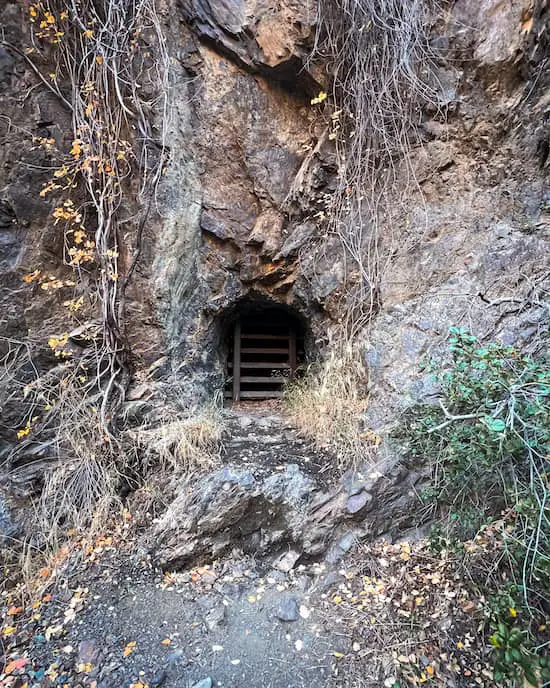
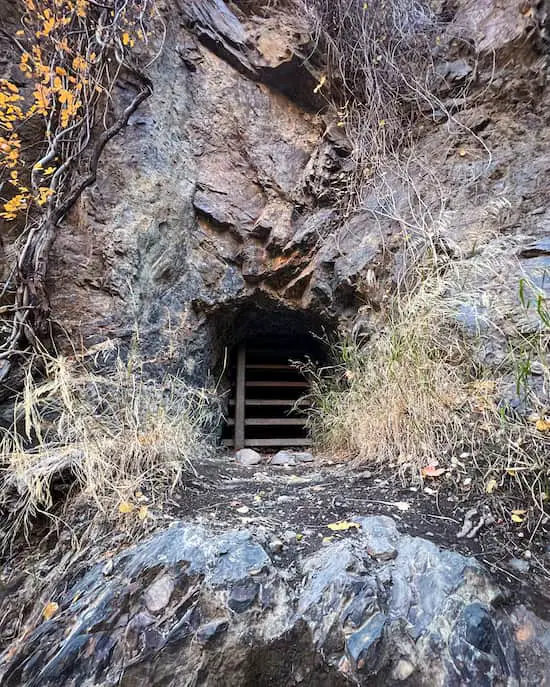
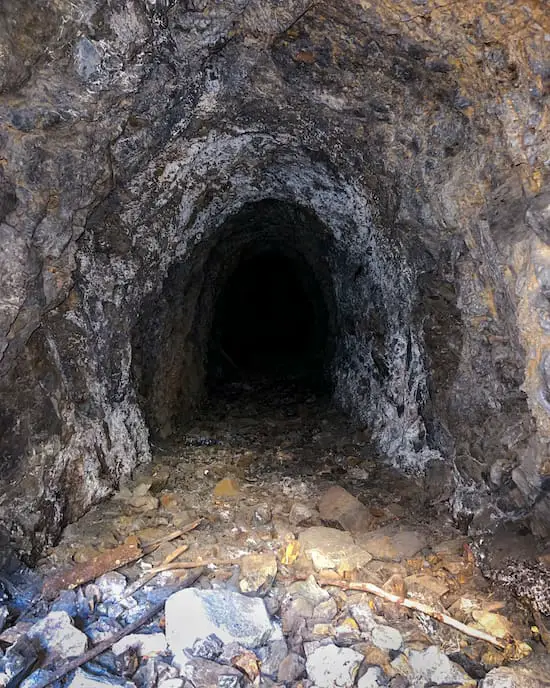
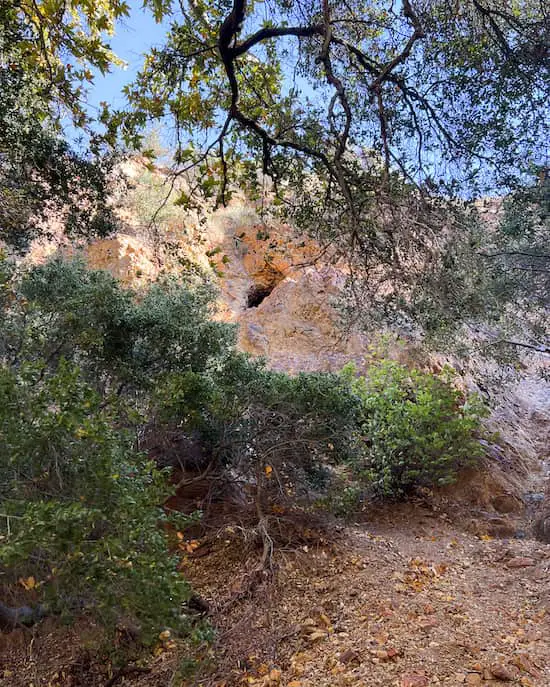
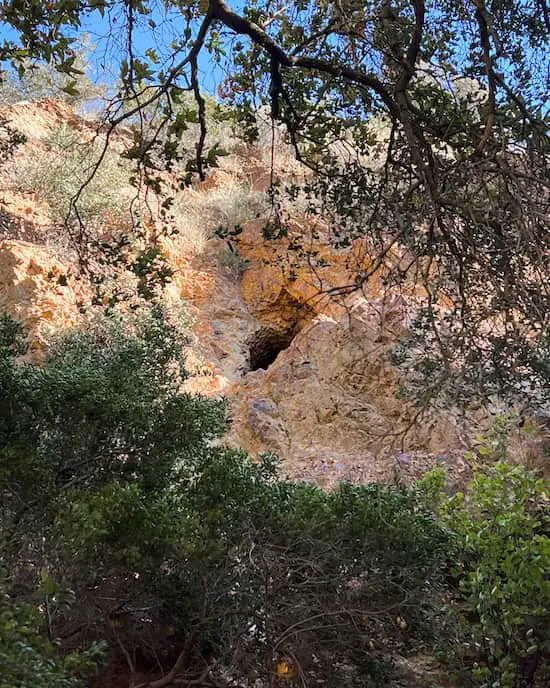
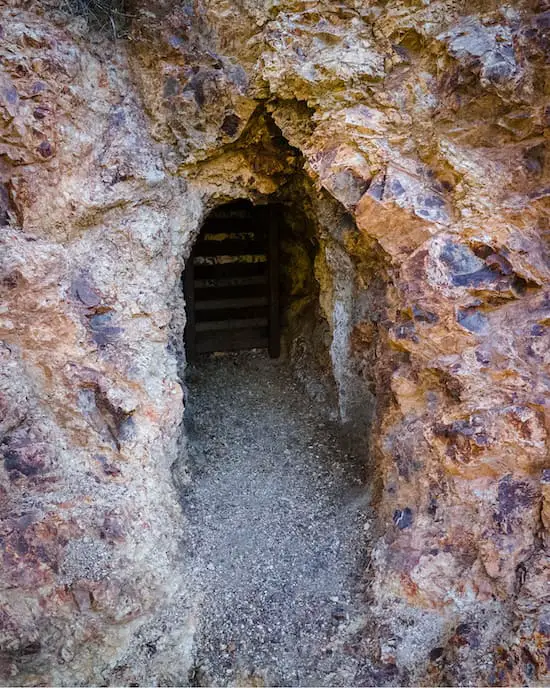
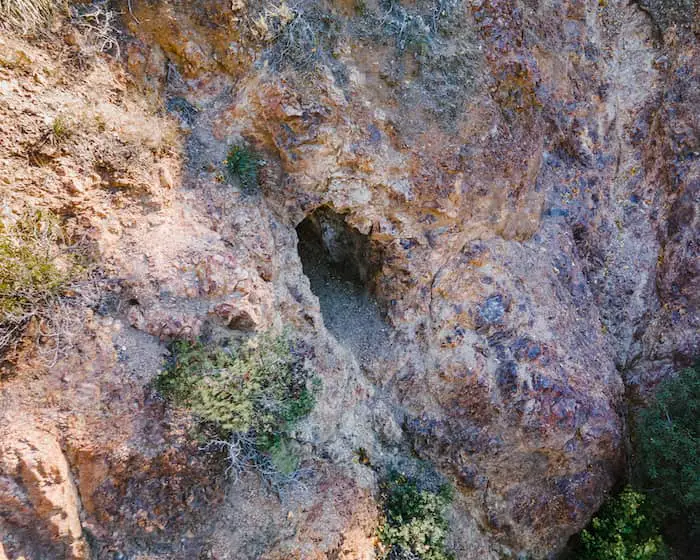
While I was still at the mouth of the tributary, I noticed an old abandoned mine on the left canyon wall.

I didn’t have time to explore it as I was running out of daylight, but it didn’t seem to go too far in.

The very beginning of the trail was extremely overgrown, as you can see from the images below. Once again, remember to wear a long sleeve shirt and pants to avoid coming into contact with poison oak!

If you like exploring caves and mines, check out the Dripping Cave in Laguna Beach! The cave was once a hideout for bandits who lived in the 1800s.

The rest of the trail was also overgrown, but nothing too bad.

I can tell this place is becoming more popular with the recent growing popularity of Holy Jim Falls further up the dirt road.

After roughly 25 minutes of bushwhacking and creek crossings, I came to a clearing in the tributary, only to find myself face to face with a beautiful 50-foot waterfall.

Falls Canyon Falls was indeed a sight to see. I felt incredibly grateful to see so much water, mainly since it rarely flows.

Falls Canyon Falls In Trabuco Canyon

The canyon smelled like mist and moss, and all we heard was the sound of leaves blowing in the wind. We had the whole place to ourselves.

Granted, we visited during the week, but even weekend visitors should experience very limited foot traffic.

Here’s a drone shot of Falls Canyon Falls, sometimes referred to as Trabuco Creek Falls. However, Falls Canyon Falls is not even located in Trabuco Creek, it simply merges into it.

The hike may be over but not the adventure!

I flew the drone further up Falls Canyon when I, to my surprise, spotted an enormous, roughly 5-tier cascade on the left side of the canyon wall.

It barely had water, but had I visited a couple of months earlier, the opposite would have been true, especially after the extremely wet winter we experienced.

Alright peeps, I hope you can get out there and hike this trail yourselves. I visited July 17, 2023, but I believe the falls will still have water at least until the second week of August.

Are you more in the mood for a hike with amazing ocean views and mild weather? Check out Top Of The World, arguably the most popular hike in Orange County.

Rubio Canyon Trail: Altadena’s Forgotten Waterfalls (Closed)

Rubio Canyon Trail: Altadena’s Forgotten Waterfalls (Closed)

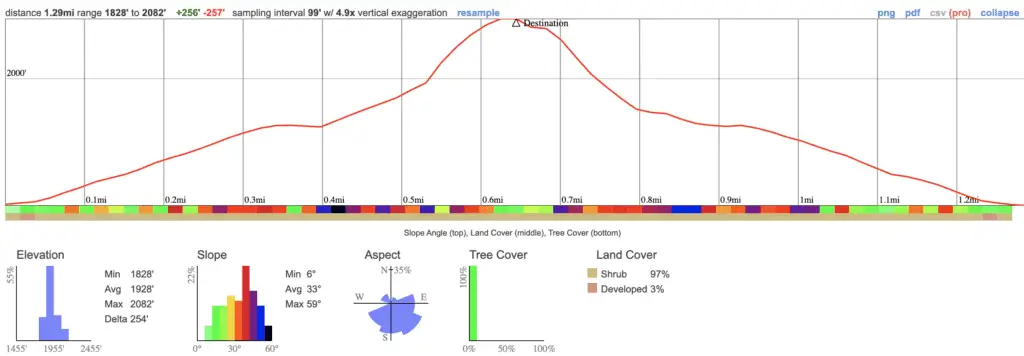
  • Miles: 1.29 Roundtrip
  • Time: 1.5 Hours Roundtrip
  • Difficulty: Difficult
  • Season: Late Spring
  • Elevation Gain: 254 ft
  • Max Elevation: 2082 ft
  • Trail Type: Out & Back
  • Parking Lot: Neighborhood Parking
  • Restrooms? Not Available
  • Dogs Allowed? Yes, on a leash

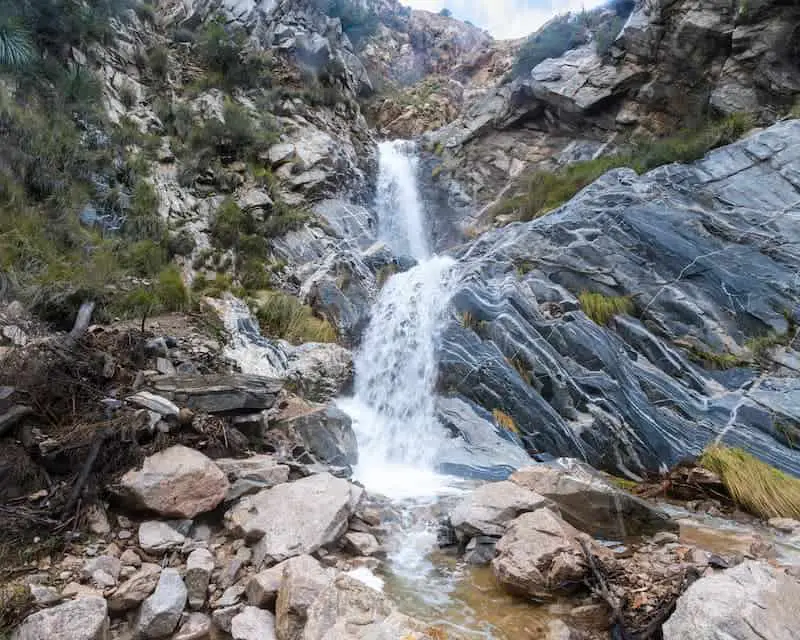
Rubio Canyon is very near and dear to me, as it holds long-forgotten history about the most fascinating time period in the San Gabriel Mountains, as well as a ton of waterfalls which only flow after extremely wet winters, such as the one we had in 2022-2023.

Please keep in mind this trail is difficult, as it requires treading through the creek for almost half the hike to get to the falls, and, at one point, boulder scrambling over ruins alongside precipitous 40-50 foot ledges. If you’re easily intimidated by heights or have poor balance, wait until you have more experience before tackling this hike.

Waterfalls found on this trail from first to last:

  1. Maidenhair
  2. Cavity Chute
  3. Bay Arbor
  4. Ribbon Rock & Moss Grotto (bottom & top tier)
  5. Grand Chasm (Rainbow)
  6. Lodged Boulder (Suspended Boulder)
  7. Roaring Rift – bottom tier of Thalehaha
  8. Thalehaha (Bridal Veil) 80ft and largest of all
  9. Leontine – Named after professor Lowe’s wife

The first 3 falls have unfortunately, been lost to history. However, there is a dry waterfall at the beginning of the trail which may be one of the first two falls.

**Note: All waterfalls after Ribbon Rock & Moss Grotto are located deeper in the canyon and cannot be viewed unless you climb up an extremely dangerous canyon wall, which I HIGHLY discourage.

At least one couple was rescued this year while attempting to scale up to the vantage point. Play it safe and don’t risk your life or the lives of the voluntary (SAR) search and rescue teams. Lastly, wear long sleeves and pants, as I was covered in ticks during my first visit in the summer of 2017.

Rubio Canyon Trail Map

powered by Advanced iFrame

Rubio Canyon Trail Elevation Profile

Download Printable PDF Map

Rubio Canyon Directions

To be redirected to the Rubio Canyon Trailhead, click the link here.

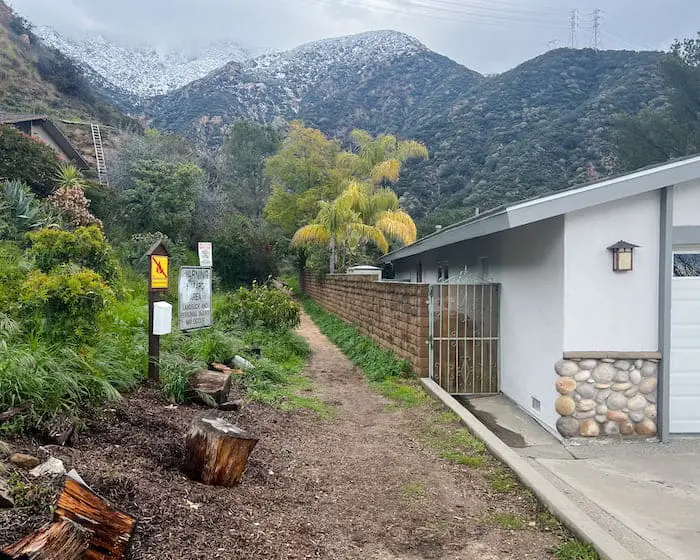
The trailhead is located in a dirt alleyway between two private homes, so please be respectful. Thank you guys! 🙂

Check out these other LA hikes!

Rubio Canyon Trail

I had been not so patiently waiting for a wet winter, and when we finally got one, Rubio Canyon was my first hike. Notice how low the snow line is in the image below.

The last time we got this much rain, I was a high school sophomore in 2005.

Rubio Canyon Trailhead

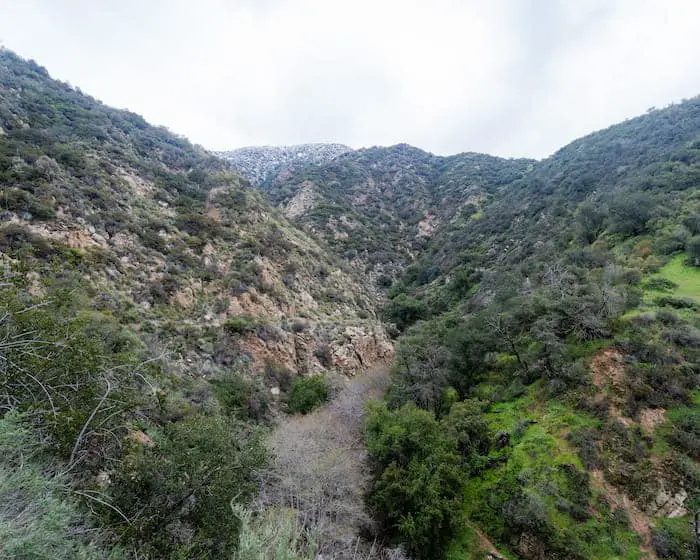
Immediately, the scenery transforms into a luscious canyon, with White Alders lining the banks of Rubio Canyon Creek. The last time I visited this place was in 2017, and I clearly remember the canyon being much drier.

Notice the bend in the image below.

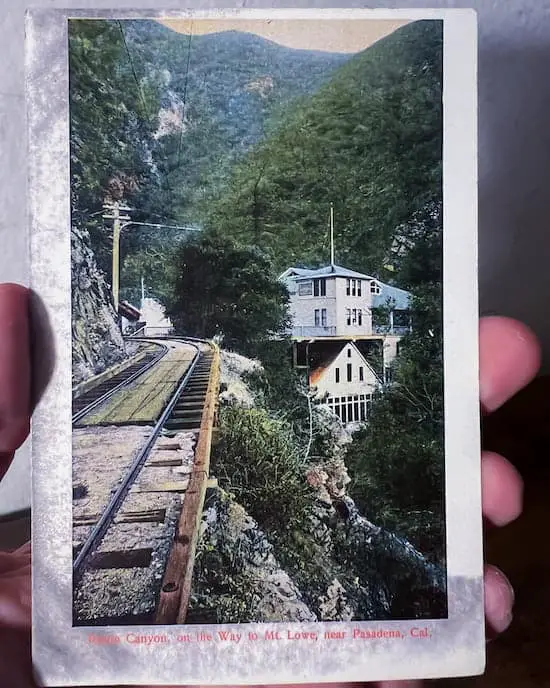
That bend is where I believe the Rubio Pavilion was once located. The pavilion, shown below as part of my collection of vintage shots, was built by Professor Thaddeus Lowe, as a one-of-a-kind attraction for visitors.

Rubio Pavilion Vintage Shot

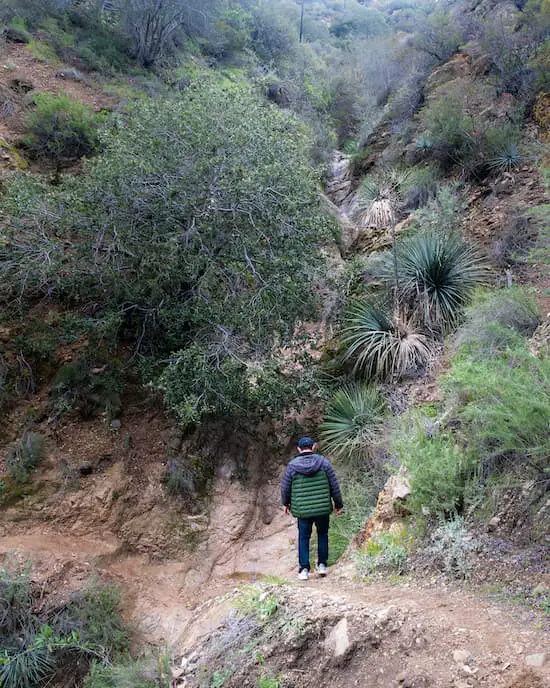
Before reaching the bend, however, I passed a dry waterfall, which I believe may be one of two falls: Maidenhair Falls or Cavity Chute Falls.

Here’s a shot of Maidenhair Falls from 1998 by the awesome hiking blog, Dan’s Hiking Pages. Check it out and see what you think. Unfortunately, I couldn’t find any shots of Cavity Chute Falls.

The Great Incline

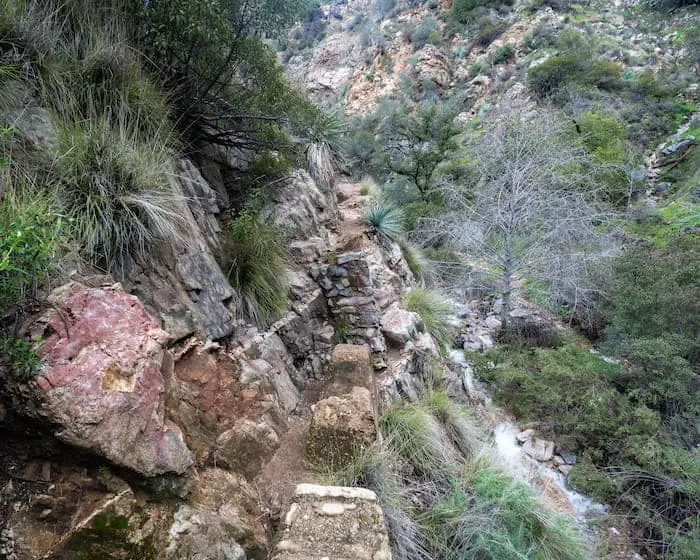
The shot below shows the most dangerous part of the trail. To continue the hike, I had to scramble up stone ruins, which I believe to be the remnants of the Great Incline.

You can either head right or left (both are the same trail). The right side, which is dangerously close to the ledge, is slightly easier to climb, as it’s less steep. However, the left route adjacent to the canyon wall is a much more vertical climb and measures about 6-8 feet.
Pick your poison and watch your step.

Rubio Canyon Ruins

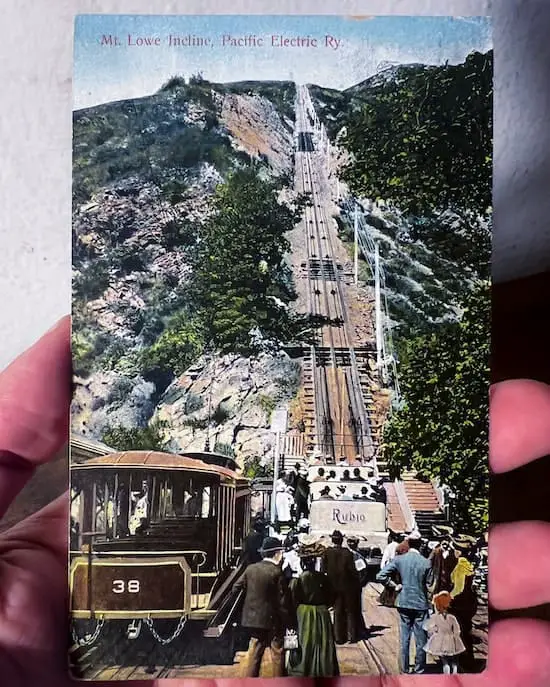
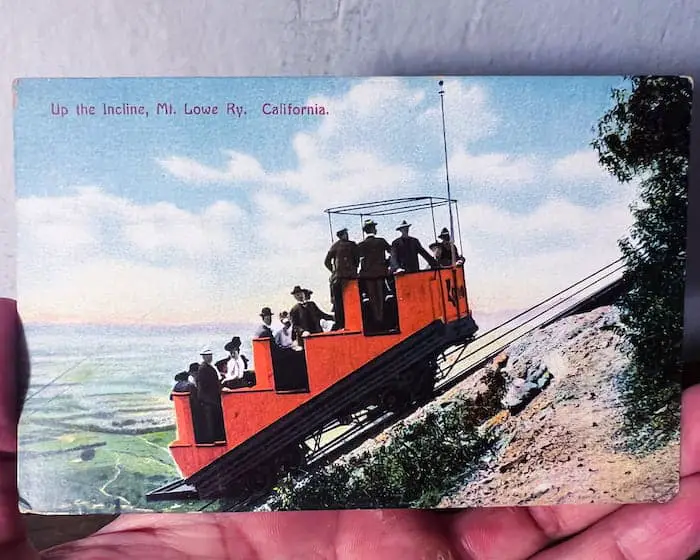
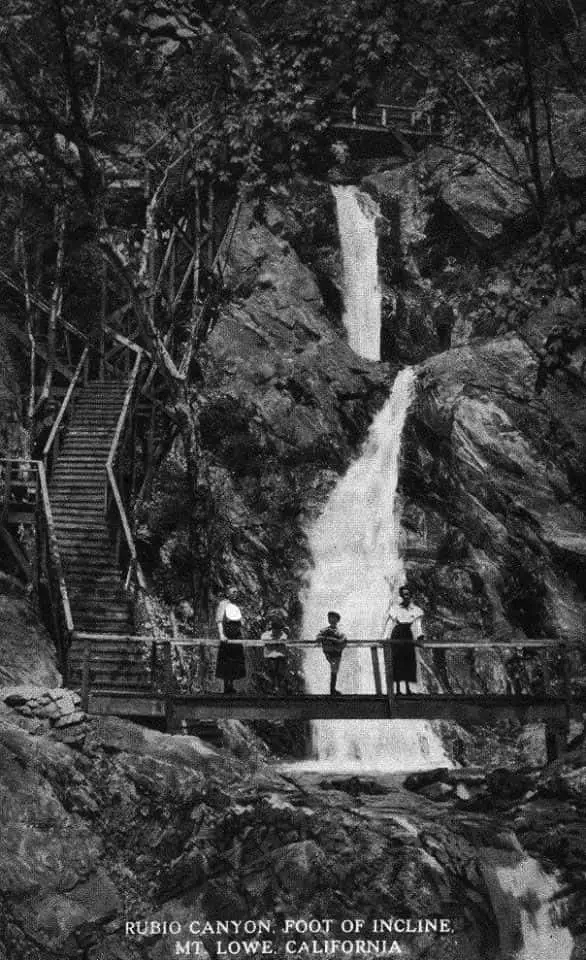
Here’s another one of my vintage shots showing what the Great Incline used to look like.

From the pavilion, visitors had the option of taking either the gradual Mt Lowe Railway (trolley at the bottom left) or riding up the Great Incline via the White Chariots to Echo Mountain, now known as the Echo Mtn Ruins.

Do you like exploring ruins? Check out the Abandoned Nazi camp in the Santa Monica Mountains.

The Great Incline vintage shot

Fun fact: although the chariots were white, I found this vintage shot of a red chariot.

Before the existence of color photography, color had to be manually added to the picture. I believe the red chariot below was probably due to an error, which is why I had to add it to my collection.

white chariots of the great incline

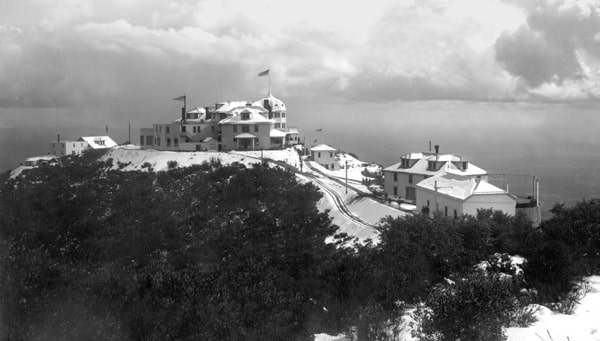
Echo Mountain ruins before they were ruins.

Echo Mountain House

Back to the trail! Another sketchy section included a 6-foot boulder scramble to the ground, but without the “death ledge” as my friends in the biking community call them.

Two things to keep in mind regarding the image below:

1. If you look to the left and behind you from where I was standing when I took the shot, you can see the Incline Railway trailhead. You can hike up to the Echo Mtn. ruins via this overgrown trail (I forgot to take the shot, don’t judge me).

2. After climbing down the boulder, I began venturing off the trail by trekking upstream.

Your feet will get wet. It’s virtually impossible to make it to the falls without walking inside the creek, at least when I visited.

Here is a shot showing the section of the hike where I began trekking off-trail.

Rubio Canyon off trail

Luckily, there is only one way to and from the falls.

I couldn’t believe I was finally looking at Ribbon Rock & Moss Grotto flowing. I waited 6 years for the opportunity.

The area surrounding the falls included a pretty large clearing and a plethora of rocks and debris.

Ribbon Rock & Moss Grotto

In fact, the bottom tier (Ribbon Rock), had been almost completely buried for the first part of the 21st century. You can see what that looked like right here. The falls aren’t as large as they used to be over a century ago.

However, most of Ribbon Rock has been uncovered in recent years.

Ribbon Rock & Moss Grotto Vintage Shot

Ribbon Rock & Moss Grotto

Want to explore another nearby waterfall? Eaton Canyon Falls is the most popular falls in LA and is only 10 minutes away from Rubio Canyon!

These shots were taken in Feb 2023. 

Ribbon Rock And Moss Grotto

Aerial view of Ribbon Rock & Moss Grotto.

Near the top of the canyon is Thalehaha Falls & Roaring Rift Falls, the latter being the bottom tier. At 80 feet tall, Thalehaha is the largest of all the falls.

Thalehaha Falls

Looking down from Grand Chasm Falls to Ribbon Rock. Can you see the three of us standing at the very bottom?

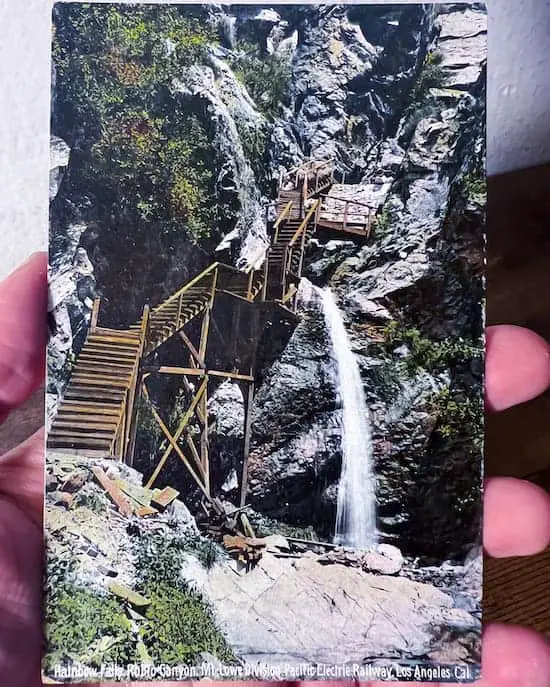
Although I don’t have a current picture of Grand Chasm (Rainbow Falls), I have another vintage shot for you. Check it out.

Grand Chasm (Rainbow) Falls

Read More: Best Waterfalls in Southern California.

Stoddard Peak Hiking Guide: Map, Directions, & Fun Facts

Stoddard Peak Hiking Guide: Map, Directions, & Fun Facts

  • Miles: 5.9 Roundtrip
  • Time: 2.5 Hours Roundtrip
  • Difficulty: Moderate
  • Season: All Year
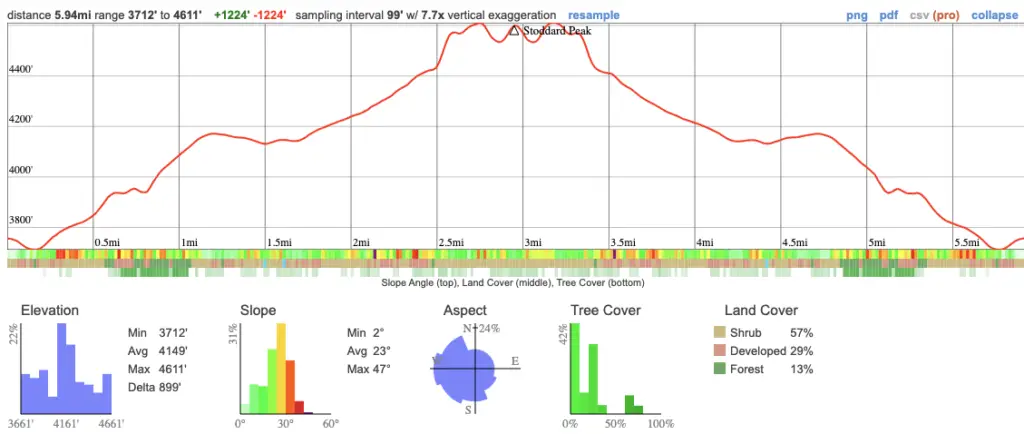
  • Elevation Gain: 1224 ft
  • Peak Elevation: 4611 ft
  • Trail Type: Out & Back
  • Restrooms? Not Available
  • Dogs Allowed? Yes, on a leash

Take a windy dirt road up Stoddard Canyon to be rewarded with breathtaking views of the San Gabriel Valley and the surrounding mountain ranges.

Stoddard Peak is a well-known summit in the Mt Baldy area that has become popular in recent years. The trail is comprised of Barrett Stoddard Rd for the majority of the hike, but the last section switches to a steep ridge line that pushes most people to their limits. Nearby peaks, like Mt Baldy and Sunset Peak, surround the summit and tower above it. Thus, rewarding the peak bagger with a stunning panorama.

Click the following link if you’re looking for Stoddard Canyon Falls

Stoddard Peak Trail Map

powered by Advanced iFrame

Stoddard Peak Elevation Profile

Download Printable PDF Map

Stoddard Peak Directions

To be redirected to the trailhead via Google Maps, click the link here.

The parking lot is full during weekends, so be sure to arrive extra early.

Check out these other amazing hikes in the area!

Stoddard Peak Trail

The trailhead is located in a parking lot, and takes you up via Barrett Stoddard Rd, named after the man who once inhabited the canyon.

Stay on the east side of San Antonio Creek to begin ascending towards the peak.

The paved road on the opposite side of the creek is the famous Mt Baldy Rd and it takes you to the waterfall.

We had received a few storms a couple of weeks prior to visiting the area, and it was noticeable. The creek was full and the road was flooded.

Barrett Stoddard Rd will lead you through a small residential area shaded by pine trees and alders. This will be the last shaded portion of the hike.

About halfway up the road, you’ll notice a large hill descending onto a meadow. This is Spring Hill.

The area looks like it may have been inhabited in the distant past.

READ MORE: 7 BEST PASADENA HIKING TRAILS

The area below is called Stoddard Flats, and here’s where it gets fun. Notice the rocks on the right side of the road? Head up that trail.

It’s quite overgrown in some areas, and can be difficult to find.

READ MORE: 2ND LARGEST WATERFALL IN SOCAL – BONITA FALLS 

The trail is very steep and loose, as it follows the ridge all the way to the peak. Watch your step!

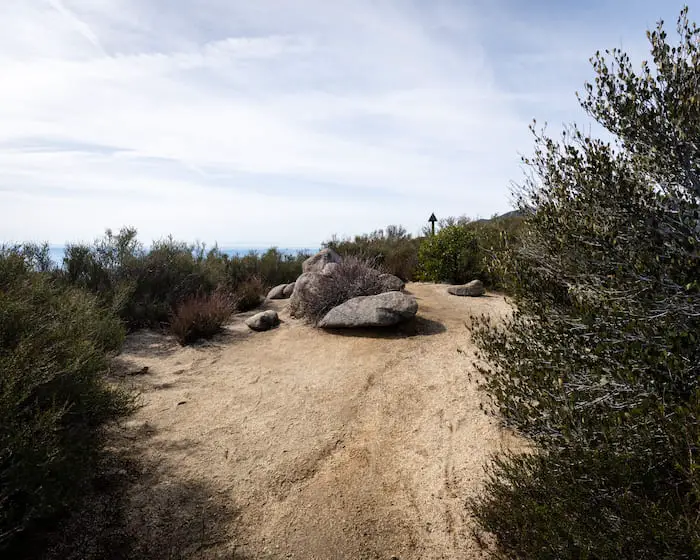
You haven’t made it to the peak until you see the marker with a number 12 on it! It’s the little post with a triangle at the top in the image below.

READ MORE: BEST HIKES IN LA: DON’T MISS OUT

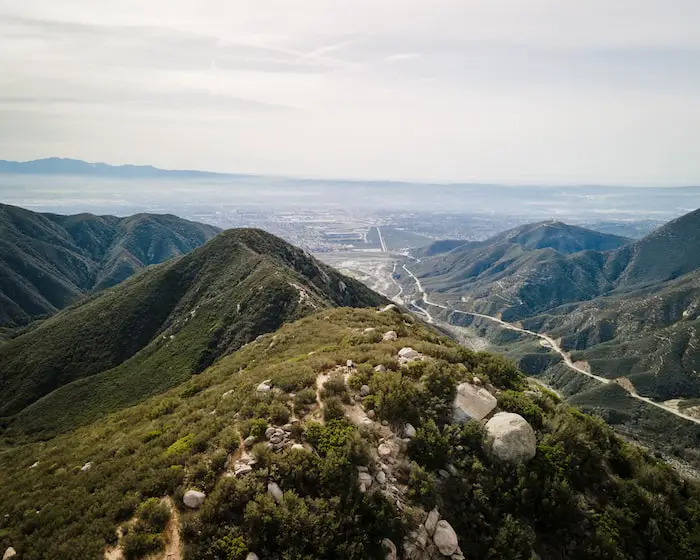
Stoddard Peak offers amazing views as far as Catalina Island, the Cleveland National Forest, and Mt Baldy towering behind you.

You’ll be able to see the road you drove up on from the peak as well as Sunset Peak.

READ MORE: 7 MUST DO WATERFALLS IN SOCAL 

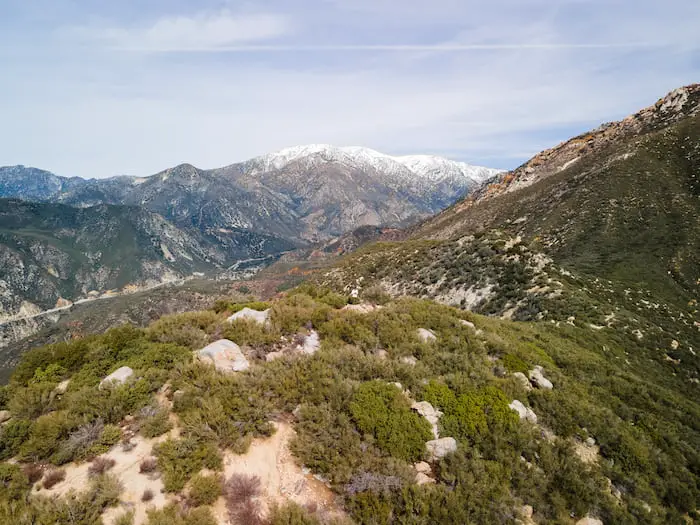
The king of the San Gabriels, Mt Baldy, made for an amazing backdrop.

I visited on a Wednesday, and had the peak to myself. Overall, it’s a great hike, especially for those who want to start bagging peaks, but aren’t ready to take on the big boys like Mt Baldy or Mt Wilson.

Head back down the way you came, and don’t forget to check out the falls when you get back down.

READ MORE: 11 BEST HIKES IN SOCAL: FALLS, RUINS, & PEAKS

Henninger Flats: Hike to a Scenic Forest Nursery (Closed)

Henninger Flats: Hike to a Scenic Forest Nursery (Closed)

  • Total Miles: 5.04
  • Time: 3 hrs
  • Difficulty: Moderate
  • Best Season: All year
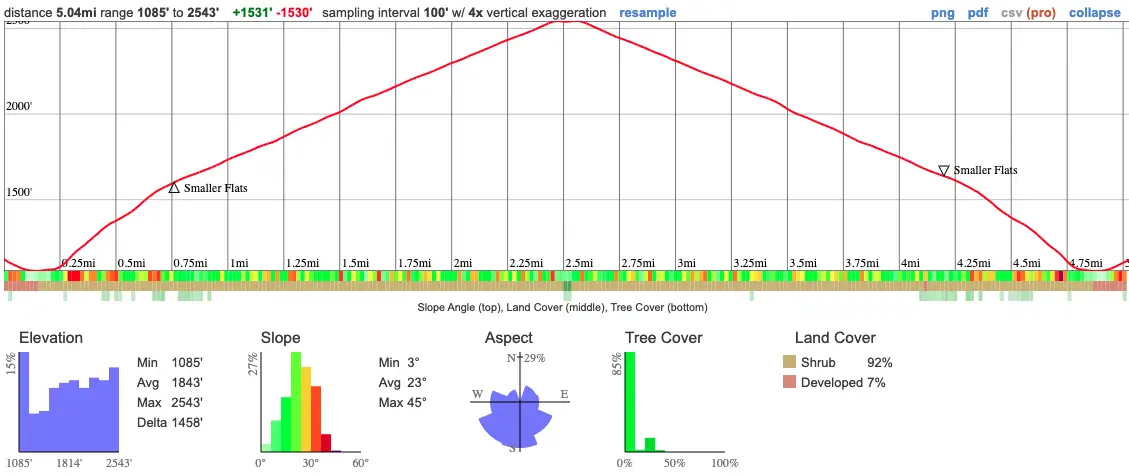
  • Elevation Gain: 1531 ft
  • Max Elevation: 2543 ft
  • Type of Trail: Out & Back
  • Dogs: Allowed on a leash
  • Restrooms: Available at the flats

Feel like learning a bit of local mountain history on your next hike? If so, I highly suggest paying a visit to Henninger Flats.

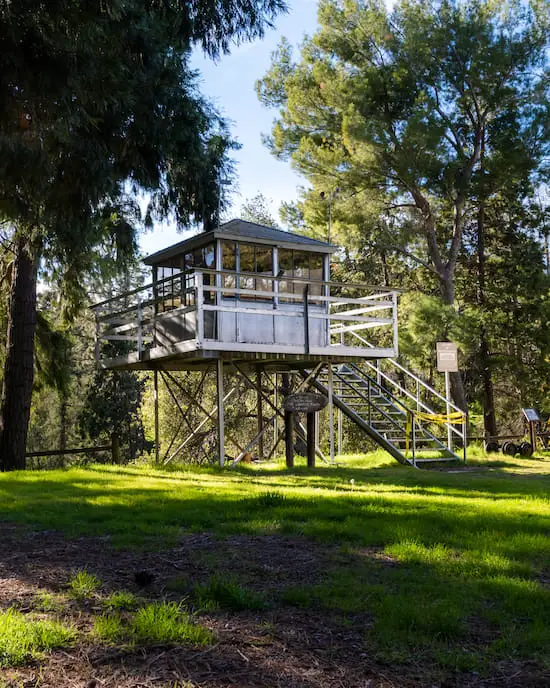
Henninger Flats Campground is a wooded flats located above Eaton Canyon in Pasadena. The hanging basin features multiple relics from local history including a fire tower, tram wheels, and a cabin. The flats also serves as a high elevation nursery for reforestation purposes, and is home to a museum. The scenery at the flats is radically different compared to the environment at the trailhead, where everything looks dead and dry most of the year. At Henninger, expect a dense canopy of tall pine trees and green grass.

Henninger Flats Map

powered by Advanced iFrame

Henninger Flats elevation profile

Download Printable PDF Map

Parking & Directions

To be redirected to the trailhead on Google Maps, click the following link: Henninger Flats Trailhead

Many people who hike to Eaton Canyon Falls also use this trailhead, so expect lots of people on the weekend.

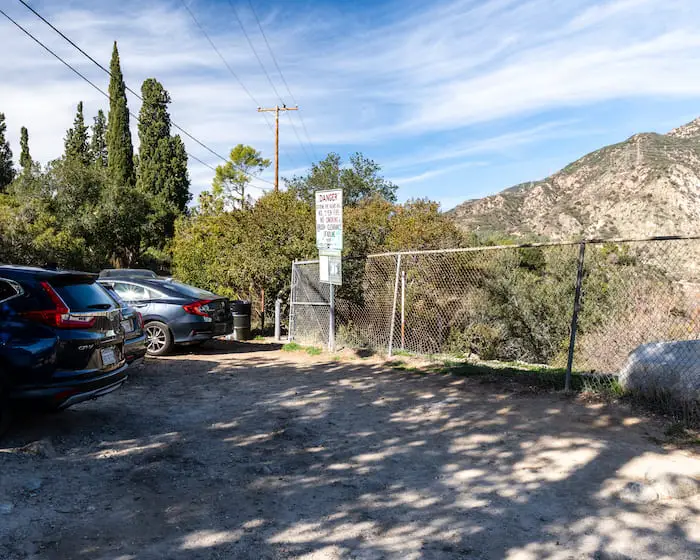
The parking lot for Henninger Flats is very small, and unless you get there really early, it will more than likely be full. If so, you can park on Midwick Dr right across the street.
Hours

The flats area is open 24/7. However, the museum/visiting center has a schedule.

Unfortunately, when I visited it was closed, and I couldn’t find its hours online, but here is their number incase you’d like to call before visiting. 626 794 0675

Helpful Links

Weather Report

Thoedore Lukens: Father of Forestry (and Henninger Flats)

Other nearby hikes you’ll absolutely love! 

Henninger Flats Trail

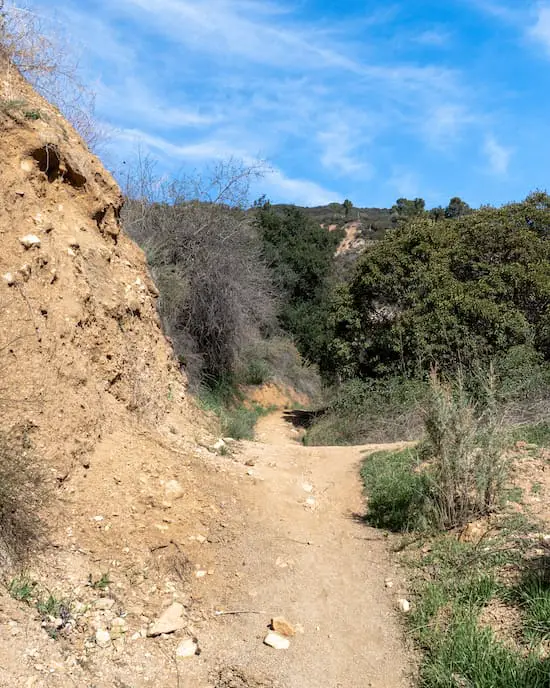
To hop onto the Henninger Flat trail, walk through the gate that is on the Henninger Flats parking lot. It will immediately descend onto the canyon floor.
Henninger Flats Trailhead

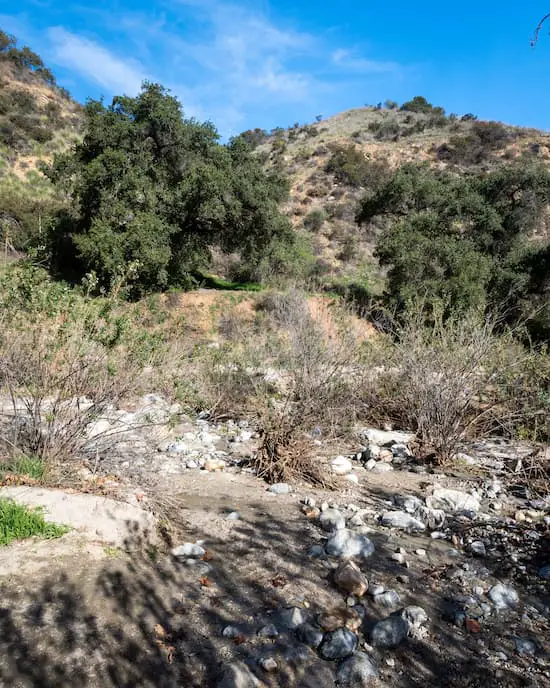
You’ll have to cross the Eaton Wash and hop onto the dirt road. Crossing the wash is safe the majority of the year.

Just be careful during the rainy season, as you don’t want to be caught in a flash flood.

Eaton Wash

After crossing the wash make a right onto the dirt road and a left to begin ascending up Walnut Canyon.

Walnut Canyon Trail

There’s a little flats area where Walnut Canyon Trail intersects with the Mt Wilson Toll Rd.

It’s shaded and offers a nice view of downtown LA. If for any reason you can’t make it to Henninger Flats, this is your next best destination.

Hop onto the Mt Wilson Toll Rd to continue up to Henninger Flats. If you look back, you’ll be able to spot Jet Propulsion Laboratory (JPL) in the distance.

It’s the cluster of white buildings in the background.

JPL from Mt Wilson Toll Road

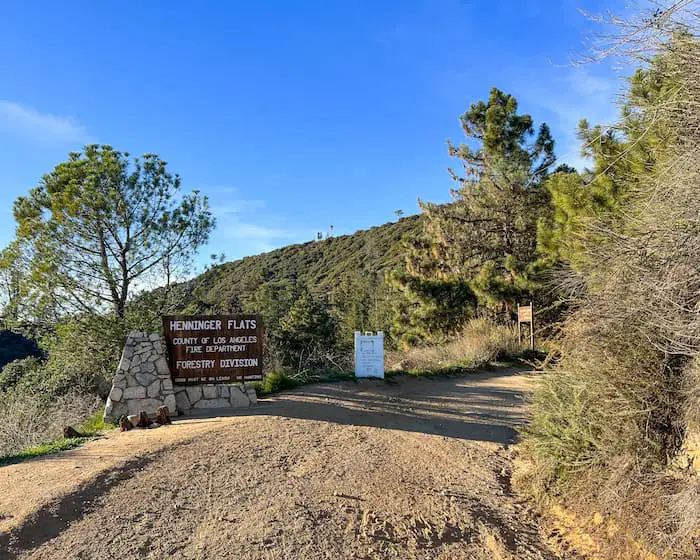
And just like that, you’ve made it to your destination.

Henninger Flats Entrance

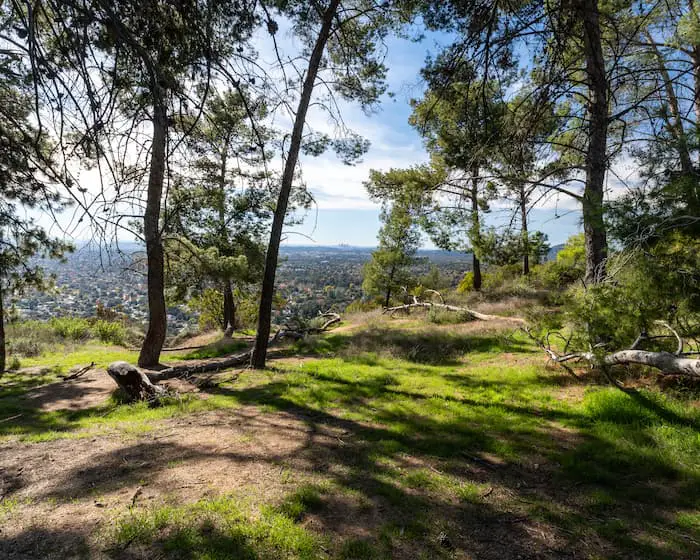
The scenery instantly transforms from dry buckwheat to pine trees and vibrant green grass.

As you’ll notice, there are multiple campsites as backpackers travel through the area.

Henninger Flats

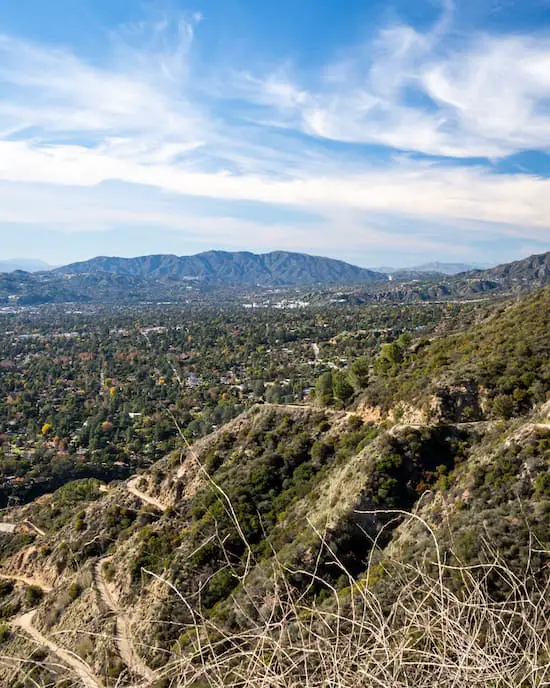
The day that we visited had extremely clear skies. We were able to see everything from the Cleveland National Forest to Catalina Island and the Palos Verdes, and hopefully you will too!

The hills closest to the ocean in the image below are the Rolling Hills in Rancho Palos Verdes.

Read More: Millard Falls: Scenic 50 ft Falls In Altadena

View from Henninger Flats

These are the best seats at Henninger in my opinion. I took the shot above while sitting on these benches.

Henninger Flats

I love how Henninger Flats features historical relics from our local mountains.

For example, a fire lookout that was once located in the Santa Monica Mts from 1925-1971 and known as the Castro Peak Fire Lookout Tower, has been permanently moved to Henninger Flats.

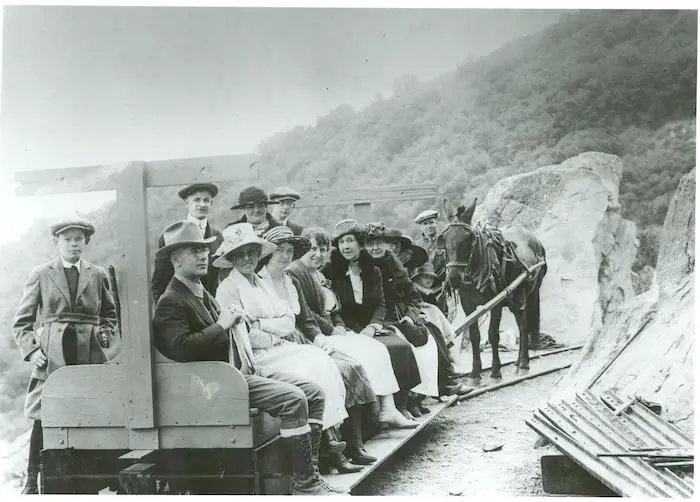
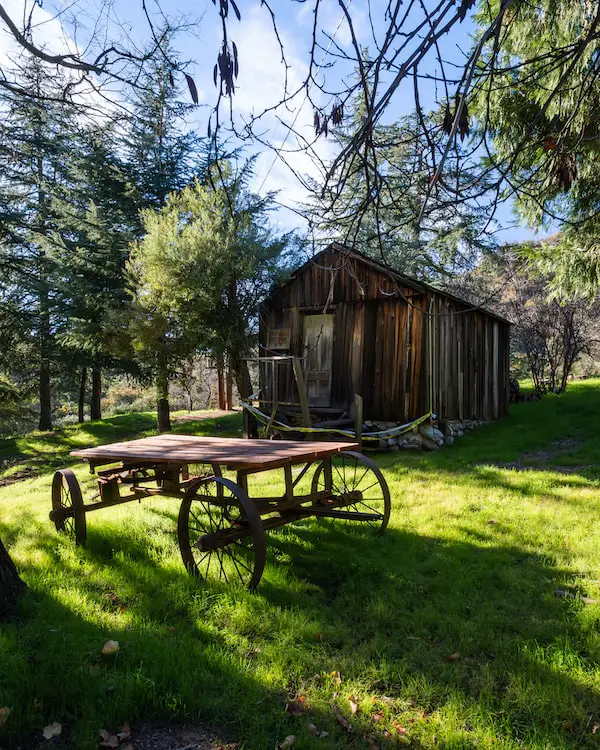
The object below is one of the two sets of wheels which belonged to the OM&M or One Man & Mule Railway.

The tram was powered by a mule named Herbert, and transported people from Inspiration Point to Panorama Point.
Read More: Eaton Canyon Falls: Most Popular Falls In LA

The famous Herbert. Courtesy of the Altadena Historical Society.
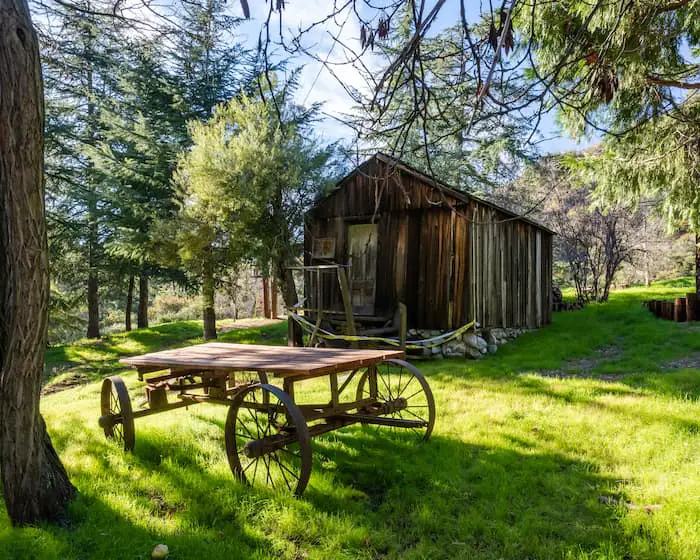
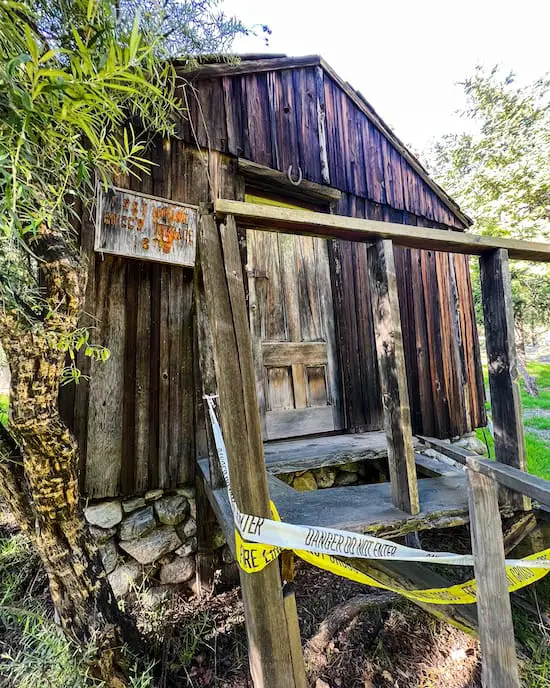
The cabin in the image below was built in 1875!!! It belonged to Theodor Pickens, the first American to settle in La Crescenta.

The area he settled was called Brigg’s Terrace. In the 1960’s, the new owner of the property had the cabin removed to Henninger Flats as a means of preserving an amazing part of our local history.

Henninger Flats

Don’t forget to check out the Henninger Flats Museum shown below.

Although I couldn’t find a schedule online, you can call this number 626 794 0675 before you visit to see if they will be open during your hike.

The nursery can be seen towards the back of the flats while Mt Fuji towers above.

Mt Fuji View From Henninger Flats

However, Henninger Flats is surrounded by many peaks. Although it’s a bit hard to see, Mt Wilson, where are the antennas are located, is in the image below.

Read More: Mt Lowe Peak: Hike To A Peak Above The Clouds

If you haven’t already, get yourself to Henninger Flats.

The area, along with its local history, will help you feel more appreciation for our beautiful San Gabriels.

Wait! Don’t go! Before you leave let’s get connected. Click the link below to join us on Instagram.

CA Hiking Adventures Instagram

Henninger Flats History

Based on SoCal maps depicting the regions controlled by our local Native American tribes, Henninger Flats was more than likely a part of the Tongva people’s region, or possibly the Serrano people.

Unfortunately, because most of our Native American history was lost, we cannot say for sure.

However, we do know that the first American settler was a man from Virginia by the name of William Kimber Henninger who arrived in the area in 1880 due to the gold rush. Henninger married a Native American woman and quickly turned Henninger Flats into a small mining operation.

However, this is where the online confusion begins.

According to James Henninger Aguirre, Henninger’s great great great grandson, his family name was intentionally misspelled and his William’s wife was incorrectly labeled as a Tongva tribesman. After much research and investigative work on his family history, James was able to prove that William’s wife was actually a part of the Serrano tribe.

Serrano means “mountain people” in Spanish, a term given to them by the Spanish because their territory included much of the San Bernardino mountains and a good portion of the San Gabriels. You can find the interesting story of the Henninger family by clicking the link here.

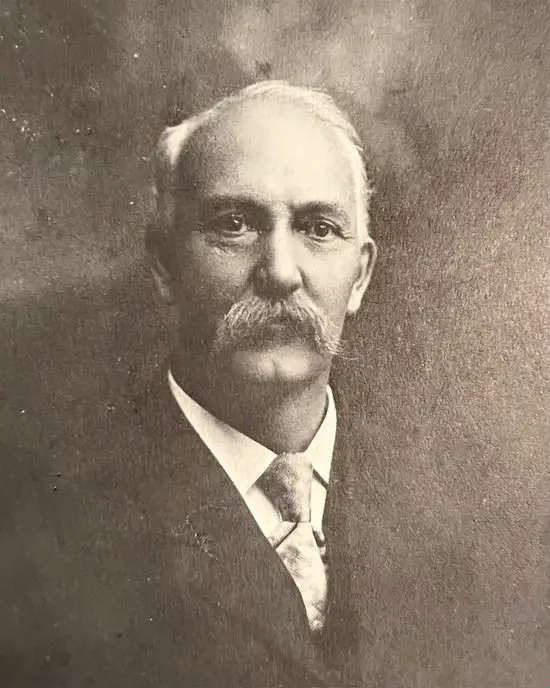
In 1892, one my favorite local mountain men and also a mayor of Pasadena, Theodore Lukens (shown below), visited Henninger in 1892 requesting a bit of land for a reforestation purposes. This is how Henninger Flats became one of the most important forest nurseries of its time.

After William died, Henninger Flats was sold to the Mount Wilson Toll Rd by his daughters. Eventually, the land came under the control of the Forest Service, as it still is this day.

However, the most significant period in Henninger Flats history was during the time of Lukens direction. Lukens leased the land from the Forest Service in 1903 and used it to carry out experimentations including the planting of conifer seeds, fire prevention, and more.

Many of the pine trees in our mountains were planted by Lukens, and they’re still there today!

According to Shirley Sargent’s book, “Theodore Parker Lukens: Father of Forestry,” Lukens received orders for seeds and seedlings from such diverse sources as Henry E. Huntington, Theodore Payne, Sen. Thomas R. Bard, Harrison G. Otis, the Mt Wilson Toll Rd Company, and locations as far away as Chile and Australia.

Additionally, one of the largest plantings supplied by Lukens in 1905 included 17,000 seedlings for the development of Griffith Park in Los Angeles!

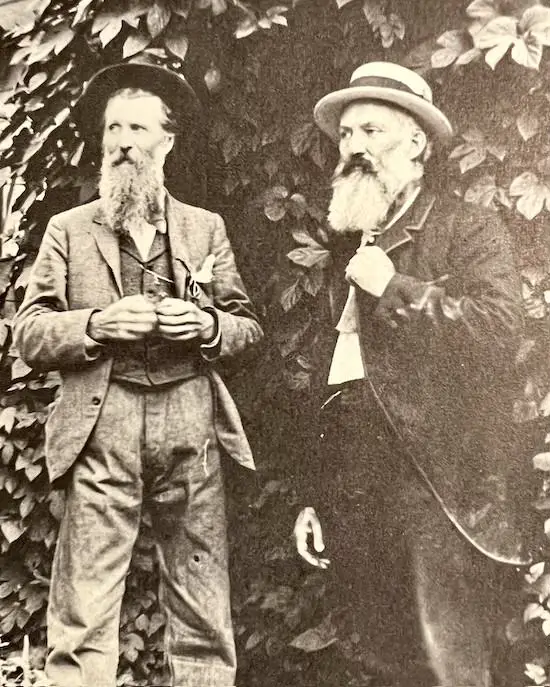
Although Lukens was removed from the reforestation project, he was not deterred. He got in touch with his buddy, John Muir (yes, that John Muir), and began advocating for watershed conservation in the San Gabriel Mts.

Our mountain patriarchs, John Muir on the left and Lukens on the right 1895.

Thanks to people like Theodore Lukens, we have been able to protect much of our beautiful San Gabriel Mountains.

FAQ

Is Henninger Flats open?

Yes, Henninger Flats is open 24/7. However, the visiting center has a set schedule.

How much elevation gain is Henninger Flats?

1531 ft

Can you hike from Henninger Flats to Mt Wilson?

Yes, simply stay on the Mt Wilson Toll Rd all the way to Mt Wilson.

Do Henninger Flats and Eaton Canyon share the same trailhead?

Only if you begin from the Eaton Canyon Nature Center. However, this post begins the hike off of N. Altadena Dr. and cuts through the Eaton Wash.

Is there shade on the Henninger Flats hike?

There is only shade in two sections on this hike. The first is about halfway up and the second is at the flats.

Can you camp at Henninger Flats? 

Yes, but campers must obtain a campground and campfire permit from the visitor center by calling 626 794 0675.

Is there water at Henninger Flats?

Yes, there is a water fountain at Henninger Flats. It’s located next to the restrooms.

Monkeyface Falls: Secret Cascade En Route to Big Bear

Monkeyface Falls: Secret Cascade En Route to Big Bear

  • Miles: No Hiking Required
  • Best Season: Mid-Late Spring
  • Max Elevation:  4400 ft
  • Parking Lot: Fits ≈ 5 cars
  • Dogs: Allowed on a leash
  • Restrooms: Not Available
  • Pics Taken On: Aug 21, 2023

Next time you find yourself on the way to Big Bear do yourself a favor and stop at the intersection of Hwy 38 and Valley of the Falls Rd to witness a spectacular seasonal waterfall.

Monkeyface Falls is one of the four enormous waterfalls in the area.This must-see gem is AT LEAST 400 ft tall (I honestly believe it may be bigger than the largest waterfall in SoCal), but it only flows after a decent amount of rain. Try to get out there no longer than a week after heavy rain or a couple of days after ordinary rainfall.

Did you know the largest waterfall in SoCal is literally 5 minutes down the street? It’s called Big Falls, a 500 ft beast of a cascade located in the sleepy town of Forest Falls.

Monkeyface Creek Falls Map

powered by Advanced iFrame

Download Printable PDF Map

Directions

Click the link here to be redirected to Google Maps. There is no parking on Valley of The Falls Rd that is close enough to view the falls, so you’ll have to park on Hwy 38.

Helpful Links

Weather Forecast

SoCal Adventure Pass (required for parking in CA mountains)

Monkeyface Falls

I flew my drone from Hwy 38 to the falls in a matter of seconds. The reason I don’t recommend hiking up to the waterfall, especially after heavy rain, is because of the two rockslides at the entrance of the tributary.

The image below is a shot of the bottom tiers.

Monkeyface Bottom Tiers

The tiers directly above look just as nice. Since I visited shortly after Hurricane Hilary, the falls had a good amount of water.

Monkeyface Falls Middle Tiers

Want to hike to another enormous waterfall which is also in San Bernardino County? Check out 495 foot Bonita Falls! It’s only a 1.4 mile hike located in the mountain town of Lytle Creek.

Here’s a shot of the bottom and mid-tiers.

Monkeyface Falls Bottom & Mid-Tiers

The waterfall was so enormous that I had to fly back hundreds of feet from the cascade in order to capture all of its tiers. The falls is easily 400-500 ft tall.

I’m not sure why they call it Monkeyface Creek Falls, as I don’t see the resemblance of any type of primate. Maybe you can spot something I don’t.

Monkeyface Falls all tiers

The truck below which looks like an ant is my Tacoma. I actually flew higher than what you see in the shot below in order to capture all of the waterfall’s tiers.

After visiting Big Falls and Monkeyface Falls, drive literally only two minutes up the road to check out Frustration Creek Falls, another one of the four enormous cascades in the area. You won’t regret it!

Sunset Peak Trail Guide: 2 Routes + Maps & Directions

Sunset Peak Trail Guide: 2 Routes + Maps & Directions

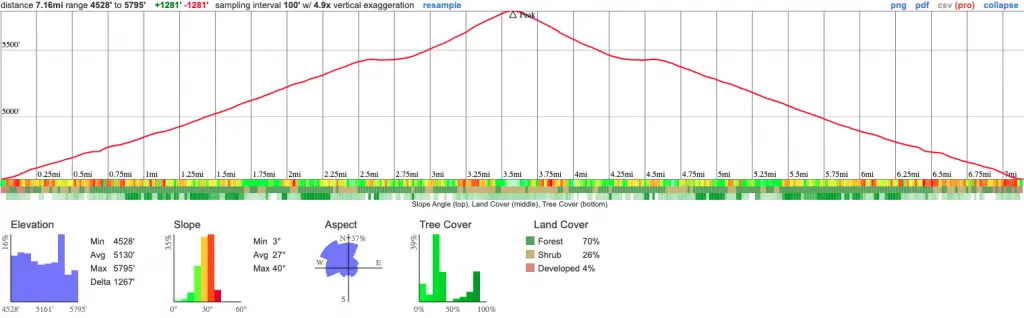
Distance 

7.2 Miles

Time

3.5 Hrs

Difficulty 

Moderate

Season

All Year

Elevation Gain

1281 Ft

  • Dogs allowed on a leash
  • Out & Back Trail
  • No Restrooms available

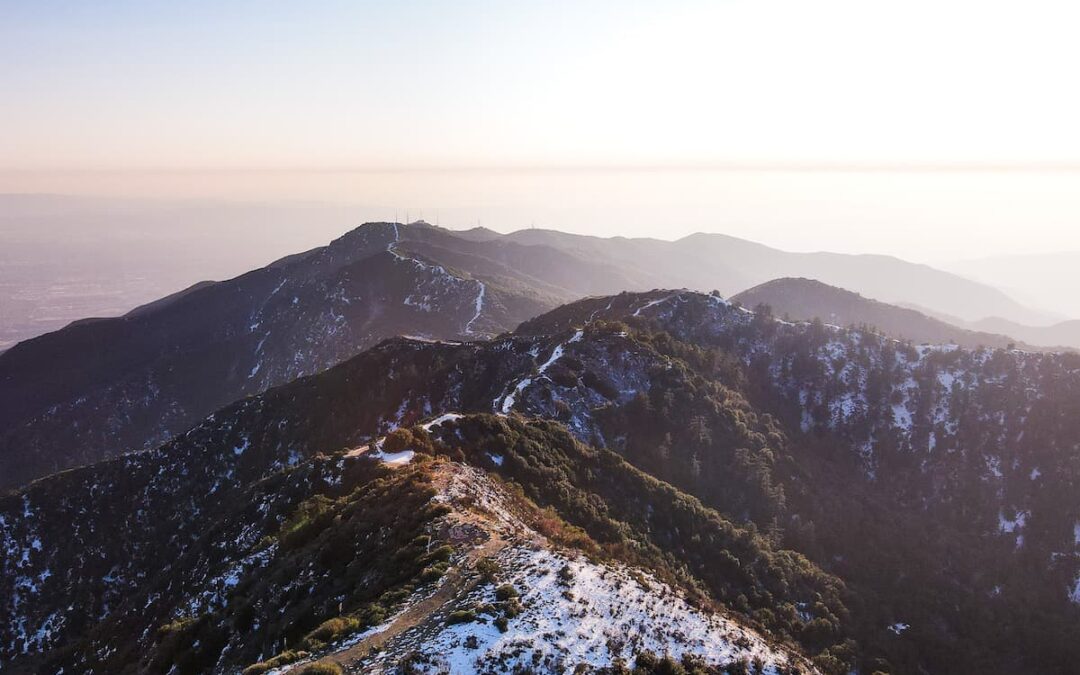
You can’t go wrong with a trail in the Mt Baldy area. Lower temperatures, possible snow, and amazing views. That’s what this trail has to offer.

Sunset Peak Trail is a moderately difficult hike in the San Gabriel Mountains featuring stunning panoramic views as far as the ocean. Meanwhile Mt Baldy towers high above Sunset Peak to the north. The entirety of the hike consists of a fire road.

Sunset Peak Trail Map

powered by Advanced iFrame

Download Printable PDF Map

The red trail is the more popular, and it’s the one I’ll be sharing about below. It involves trekking up a dirt road for the entirety of the hike.

Sunset Peak Address & Directions

To be redirected to the trailhead on Google Maps, click the link below.

Glendora Ridge Rd, Mt Baldy, CA 91759

Check out these other amazing hikes in the San Gabriel Mts!

Sunset Peak Trail

Sunset Peak Trail begins at Cow Canyon Saddle. Walk past the yellow gate and up the dirt road to get started.

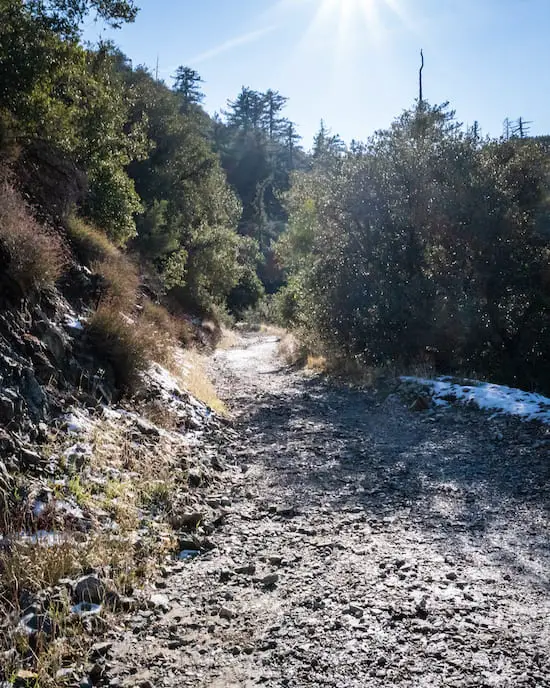
Most of the trail is located on the dark side of the mountain, which means the snow will tend to last a little longer. However, the same cannot be said of the peak.

From the start, Cow Canyon and Coldwater Canyon split the mountain range and provide an amazing view as far as Mt Wilson and Strawberry Peak.

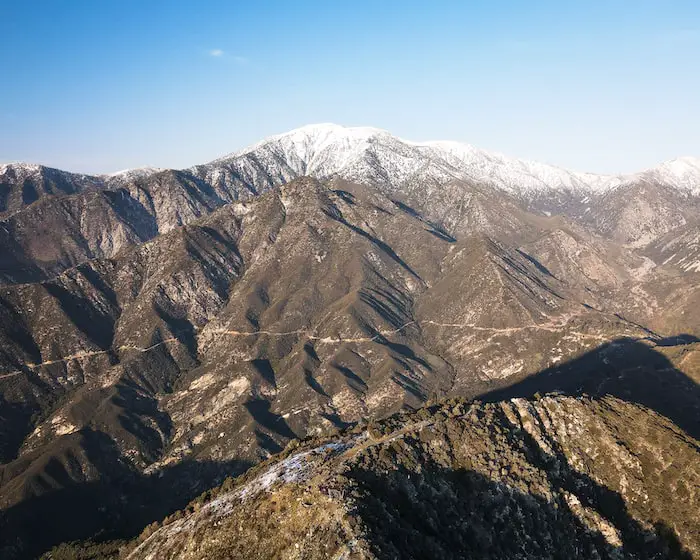
Glendora Mountain Road (GMR) is the road which you traveled up to get to the trailhead. You can see it on the lefthand side weaving its way far into the distance.

READ MORE: 7 BEST PASADENA HIKING TRAILS

The trail has no splits up until you reach this dirt lot. Instead of heading straight, turn around and continue heading up the mountain.

You’ll be facing Mt Baldy as it looms high overhead in the distance, making itself well known as the king of the San Gabriels.

We visited two days after a good dump. The shady side of the mountain still had snow and even icicles in certain areas.

READ MORE: BEST HIKES IN LA: DON’T MISS OUT

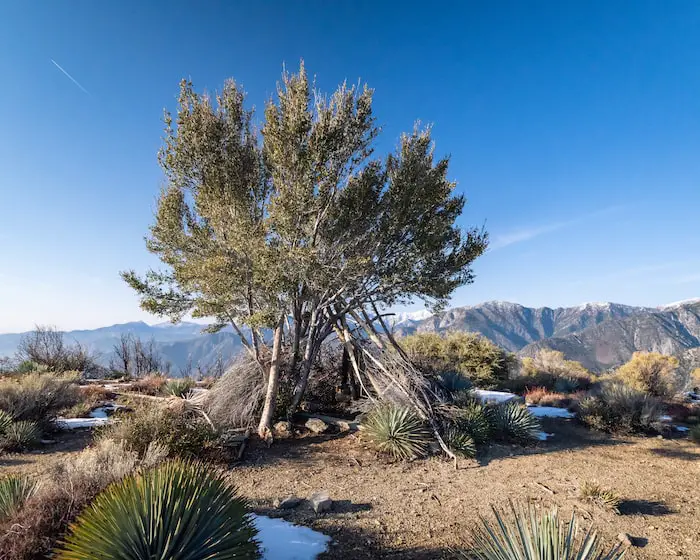
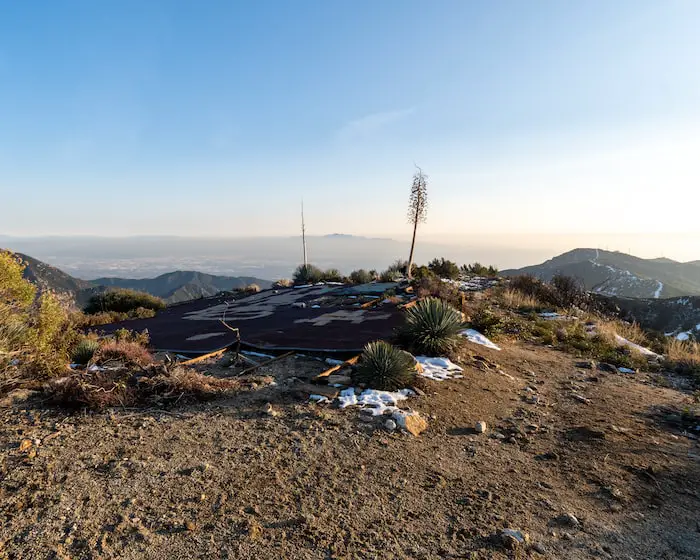
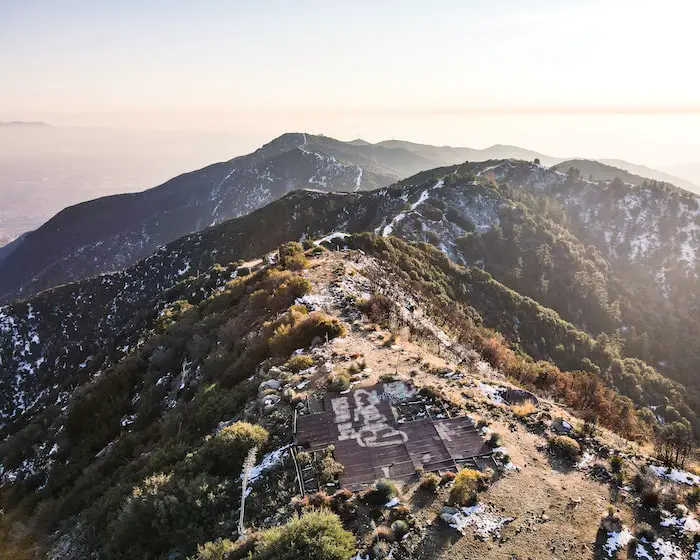
Someone built a shelter at the peak. It wasn’t exactly well suited for an overnight stay, but it gets the job done for a temporary visit at the peak lol.

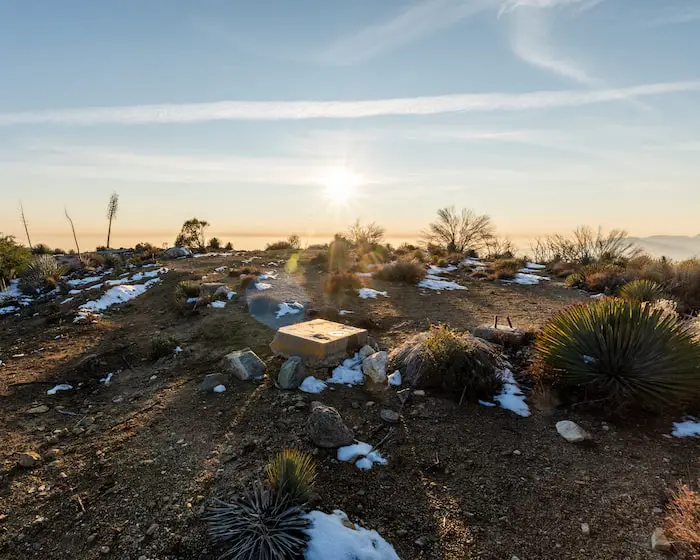
The concrete blocks shown below were once the foundation of a fire tower that was located at the peak.

Unfortunately, there was so much smog that we couldn’t see much into the valley, but the views of Mt Baldy and the neighboring peaks more than made up for the loss.

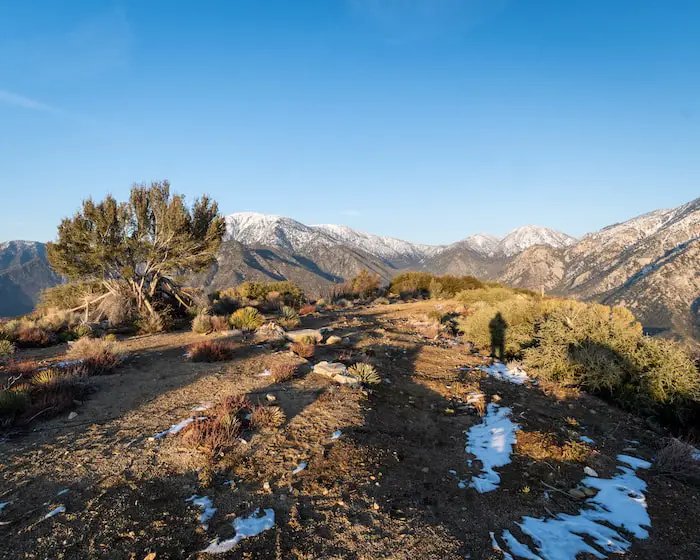
Spring Hill shown below is a neat looking saddle. I’d like to explore that soon as it shows signs that someone was settled there in the past.

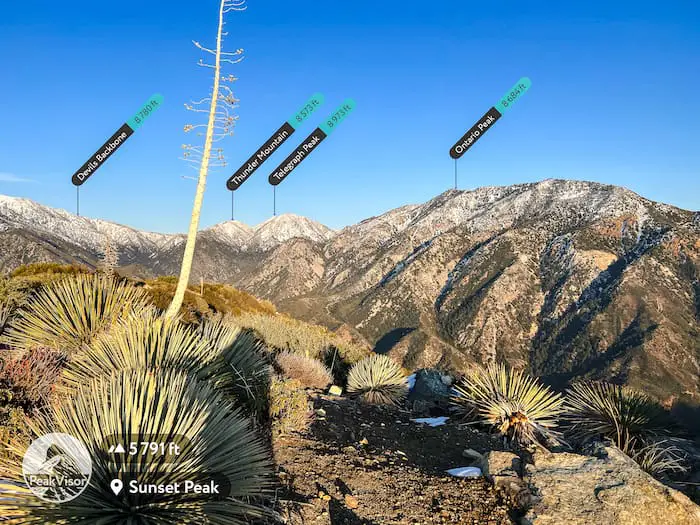
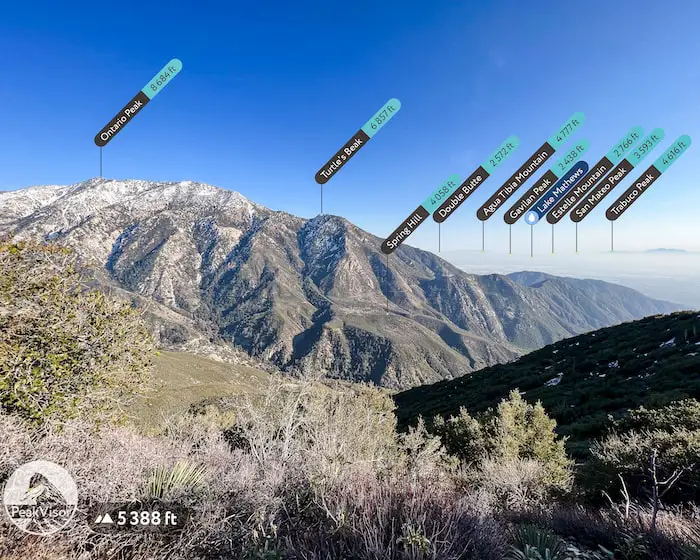
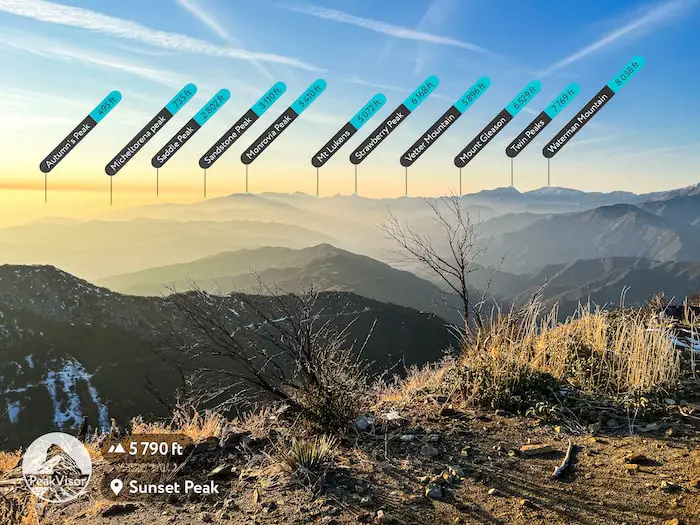
By the way, I used the app Peak Visor to identify peaks on my hikes. 

READ MORE: 2ND LARGEST WATERFALL IN SOCAL – BONITA FALLS 

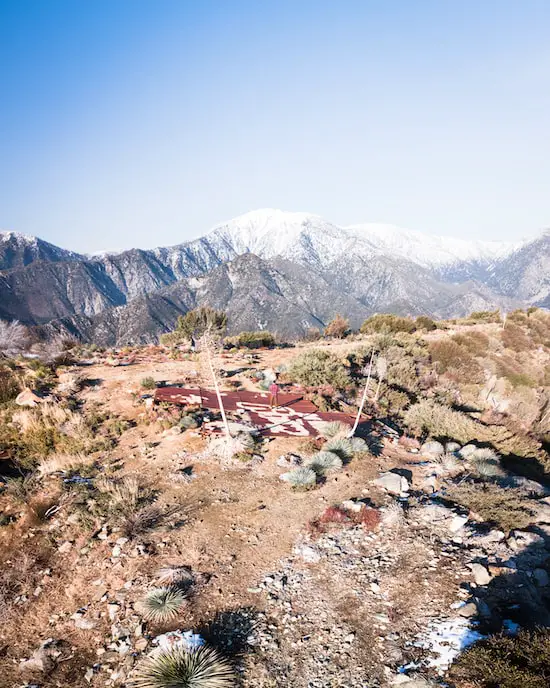
You can’t say you made it to the peak until you’re standing on top of the old sheet metal roof!

The peak in the distance is Santiago Peak, the highest point in the Cleveland National Forest.

To the west, the entire skyline is filled with San Gabriel Mt peaks.

READ MORE: 7 MUST DO WATERFALLS IN SOCAL 

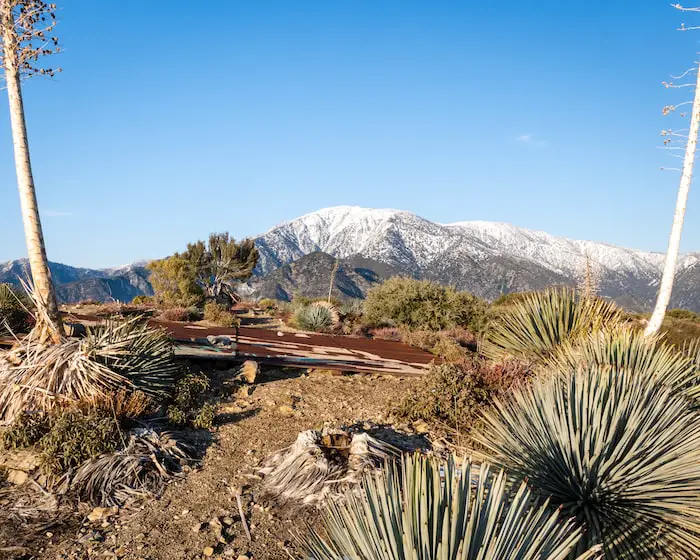
The Baldy Bowl on Mt Baldy is shown in the background.

READ MORE: 3 BEST HIKES IN LAGUNA BEACH

READ MORE: 7 BEST SAN DIEGO HIKES

READ MORE: 11 BEST HIKES IN SOCAL: FALLS, RUINS, & PEAKS

Etiwanda Falls Trail: Most Popular San Bernardino Hike

Etiwanda Falls Trail: Most Popular San Bernardino Hike

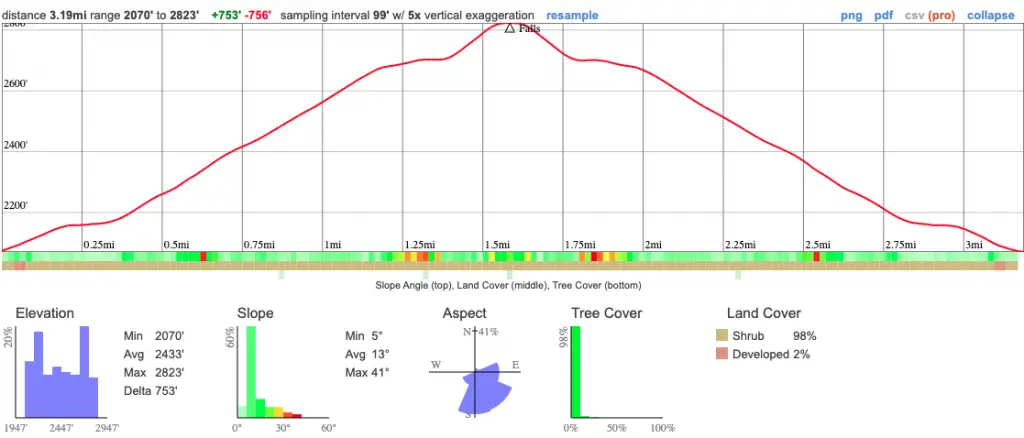
  • Miles: 3.19
  • Time: 1.5 hrs
  • Difficulty: Easy
  • Best Season: Spring
  • Elevation Gain: 756 ft
  • Max Elevation: 2823 ft
  • Type of Trail: Out & Back
  • Parking Lot: Dirt Lot Fits 30+ Cars
  • Dogs: Not Allowed
  • Restrooms: Not Available
  • Trail Popularity: Very High
  • Pics Taken On: Nov 30, 2022

According to All Trails, Etiwanda Falls has the most reviews out of any hike in San Bernardino County. So of course, I planned a visit to see what all the fuss was about.

Etiwanda Falls Trail leads to a popular 15-20 ft cascade in North Etiwanda Preserve. The moderately difficult hike primarily consists of a shadeless dirt road surrounded by the well-known chaparral frequently seen in low mountainous elevations. However, upon arriving at the falls, the scenery transforms into a luscious riparian woodland.

I dubbed Etiwanda Falls as one of the must-do waterfalls in Southern California. However, it’s far from being at the top of the list. Check out the link below to view the complete list.

SoCal’s Best Waterfalls

Etiwanda Falls Trail Map

powered by Advanced iFrame

Etiwanda Falls Elevation Profile

Download Printable PDF Map

Address & Directions

To be redirected to the trailhead via Google Maps, click the following link: Etiwanda Ave, Rancho Cucamonga, CA 91739

Helpful Links

Weather Report

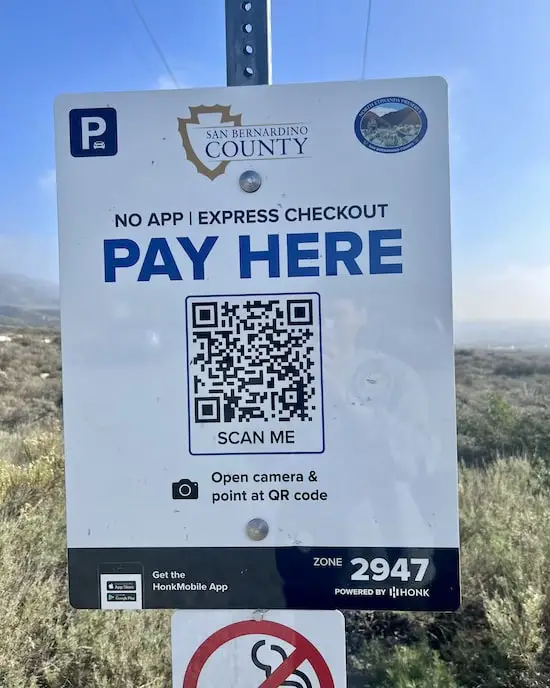
Click one of the following links to download the HonkMobile App on iPhones or Androids to pay for your parking permit, or scan the QR code below.

Etiwanda Falls parking QR code

Expect enormous crowds on the weekends.

**Check the hours below so you don’t get locked inside the parking lot after they close the gate.**

Etiwanda Falls Hours

Summer Months Mar – Oct: 6:30 am – 8:00 pm

Winter Months Nov – Feb 6:30 am – 5:00 pm

Etiwanda Falls Trail

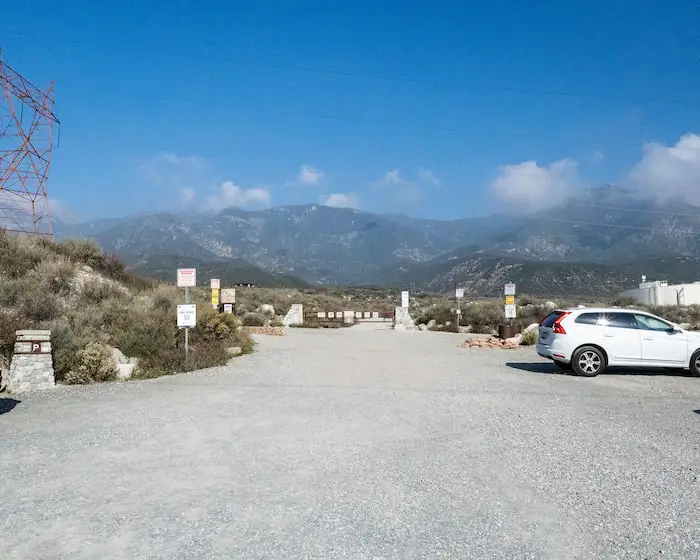
After paying the parking fee, I headed straight through the next gate and towards the mountains.

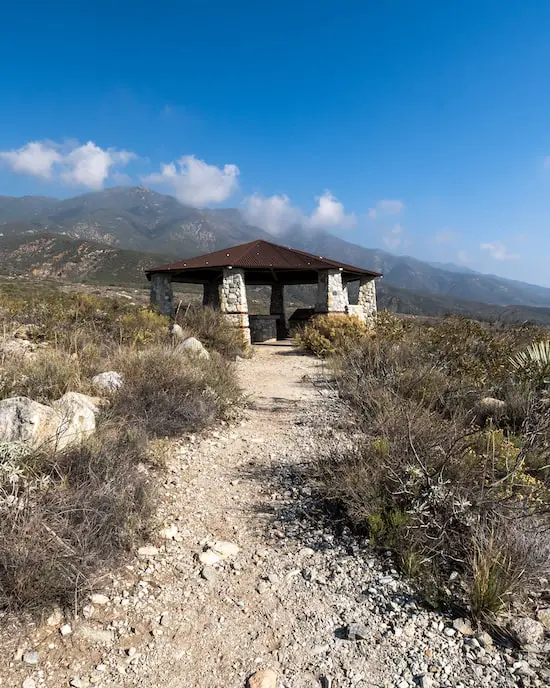
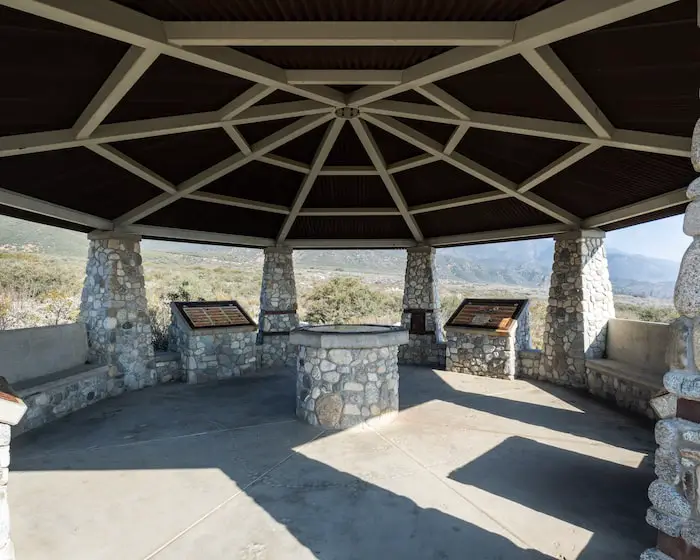
Although not on the map, the pavilion below is easy to spot, and features interesting information regarding the area, its history, endangered species, and plants.

I highly recommend it, as it’s only a 1-minute detour.

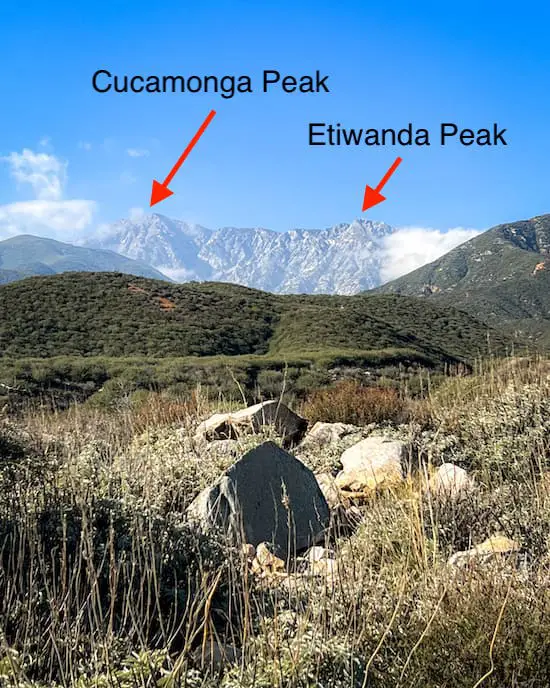
I’ll be completely honest with you. The trail is a not-so-exciting dirt road, but luckily I had an amazing view of the valley to the south, Cucamonga and Etiwanda Peak towering above to the north,

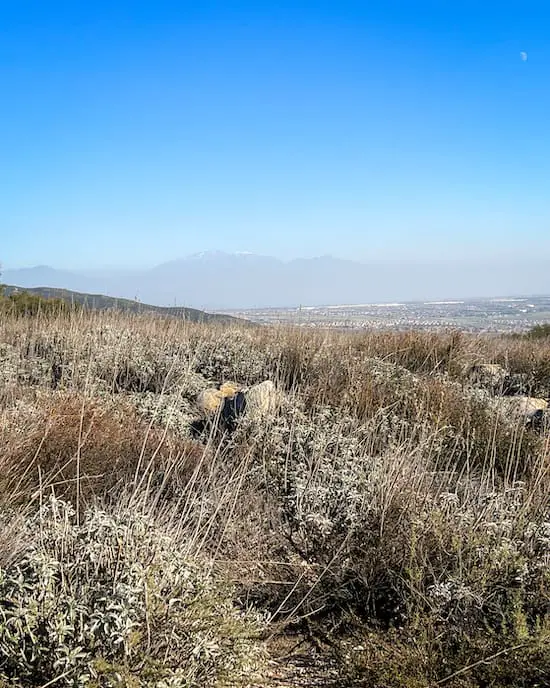
Below, is Old Greyback (San Gorgonio) to the east.

These peaks can be hiked, but they’re not beginner-friendly. If you’re in the mood for peak bagging but prefer a moderately challenging trail, try Sunset Peak or Stoddard Peak. Both are great intermediate hikes located in San Antonio Canyon.

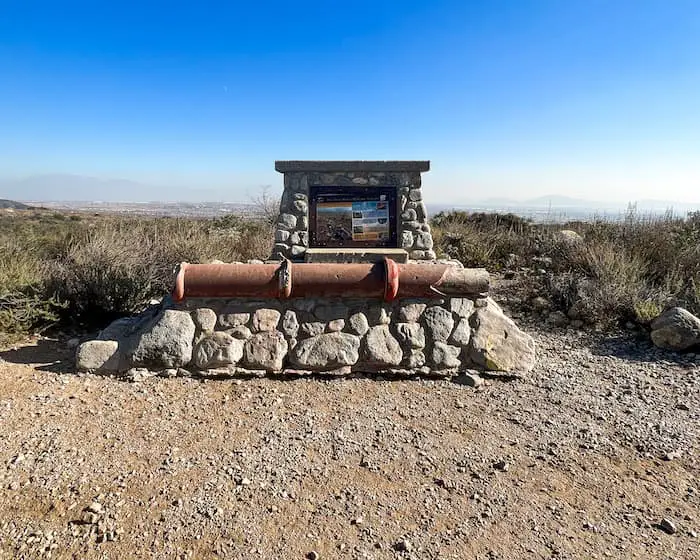
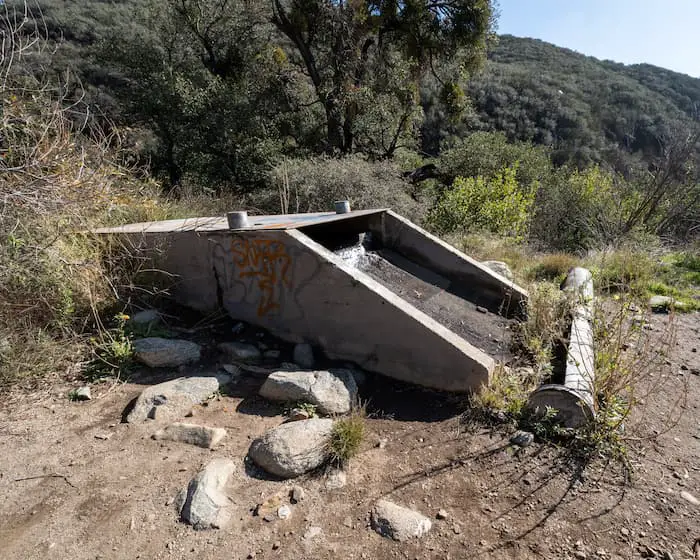
Further up the road, I came across a late 19th century water pipe that once allowed ranchers and farmers to harness the waters of East Etiwanda Creek.

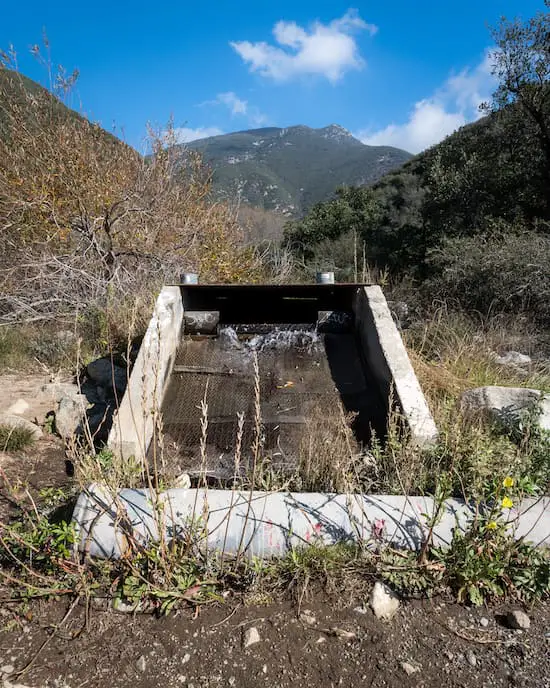
The structure shown below is known as an overflow drain and was used along with water pipes to prevent flooding.

Hopefully, it’s flowing during your visit as it was on mine.

After hiking underneath the merciless sun and on the rutted road, I arrived at mountain paradise.

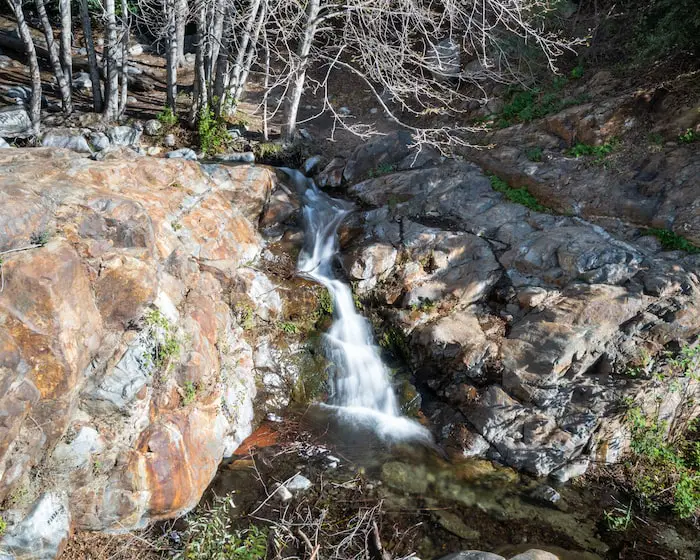
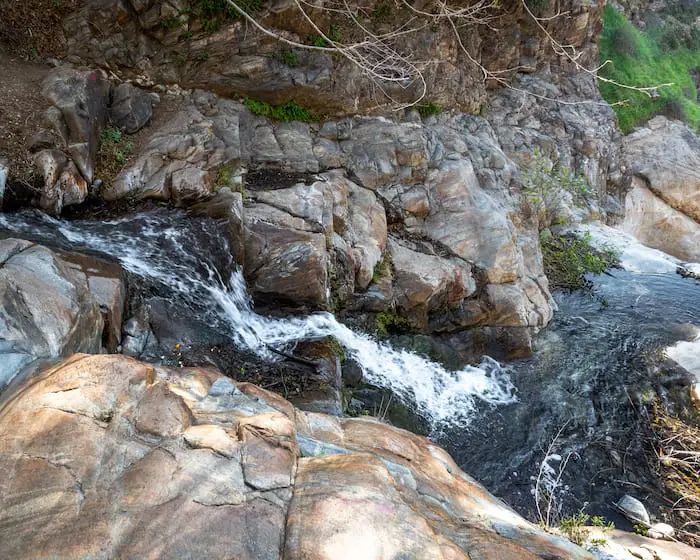
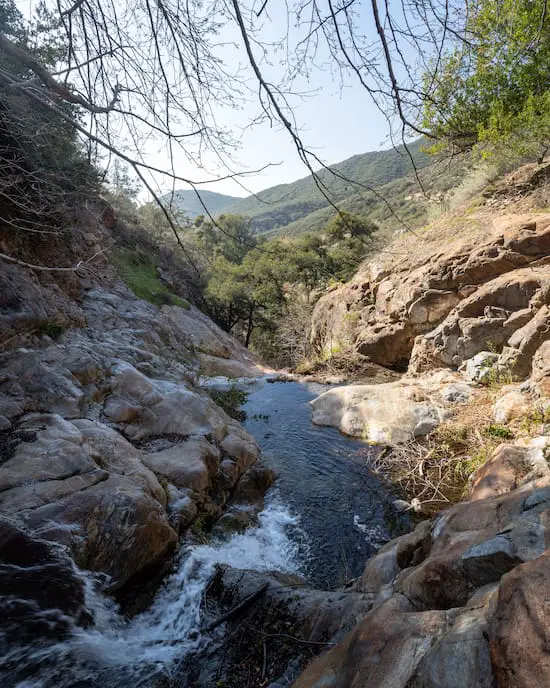
At the top of the falls, I had a stunning view of the East Etiwanda Canyon mouth opening up and the creek gushing over the second much smaller falls.

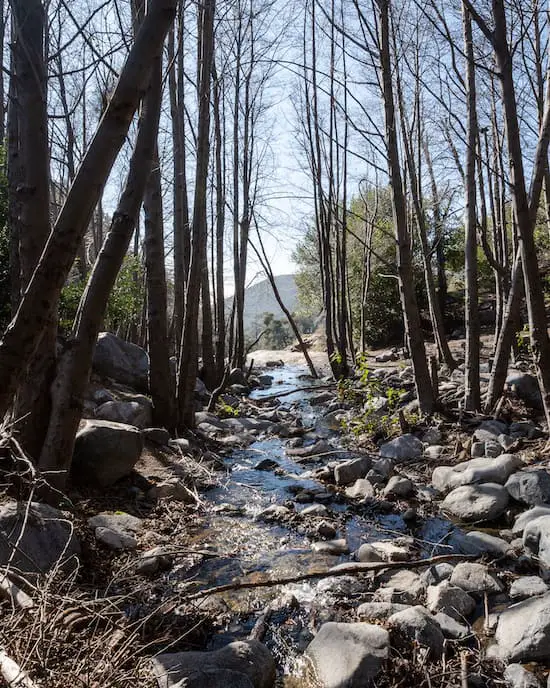
Deeper into the canyon, White Alder trees decorate the landscape, making it look like a wooden scenery normally seen in movies.

You would never think to see a waterfall like this in Rancho Cucamonga.

I’m not sure how Etiwanda Falls is more popular than the biggest waterfall in SoCal, a colossal 500-foot multi-tiered waterfall, or Bonita Falls, the second largest. Both hikes are easier than Etiwanda Falls and the trails are more scenic. Check them out by clicking the link.

Etiwanda Falls

The second much smaller waterfall resembling a slide is located below Etiwanda Falls and directs the creek into a pool. However, I don’t recommend climbing down, as it’s steep and dangerous.

Speaking of slides, you NEED to do yourself a favor and hike to the beautiful Stoddard Falls with a rockslide and pool in San Antonio Canyon. The water is crystal clear and deep enough to swim in.

Etiwanda Falls lower tier

I was shocked to see this much water flowing in December, especially after a dry season. I guess that just like San Antonio Waterfall near the Mt Baldy area, Etiwanda Falls has become very popular due to its annual flow. The former, however, is much more impressive.

Etiwanda Falls

Don’t get me wrong, Etiwanda Waterfall is beautiful, but I must admit, it’s nowhere near as stunning as 25 ft Heart Rock Falls located in Crestline, a forested town deep in the San Bernardinos.

It’s relatively close to Etiwanda Preserve, so you could hike both trails on the same day if you wanted to.

Recommended Gear

North Etiwanda Endangered Species

North Etiwanda Preserve is home to a wide variety of animals, but unfortunately, some face the threat of extinction.

The following 10 species have been classified by the US Department of Interior and the State of CA as endangered, threatened, or species of special concern.

Please, always pack out what you pack in.

  • San Diego Horned Lizard – special concern
  • Mountain Yellow-legged Frog – endangered
  • San Diego Ring-necked Snake – special concern
  • LA Pocket Mouse – special concern
  • San Bernardino Kangaroo Rat – endangered
  • Southwestern Willow Flycatcher – endangered
  • Bell’s Sage Sparrow – special concern
  • Rufous-crowned Sparrow – special concern
  • Least Bell’s Vireo – endangered
  • Coastal California Gnatcatcher – threatened

Etiwanda Falls Trail Plants

Don’t forget to keep an eye out for these plants while you’re on the trail. Some can be seen year-round, while others are seasonal.

  • Chamise
  • California Sagebrush
  • Bigberry Manzanita
  • Plummer’s Mariposa Lily
  • Mule Fat
  • California Lilac
  • Blue Dicks
  • Scale Broom
  • California Fuchsia
  • California Buckwheat
  • Stinging Annual Lupine
  • Canyon Live Oak
  • White Sage
  • Our Lord’s Candle (Yucca)
  • Poison Oak
  • California Wild Grape
  • Black Sage
  • California Brittlebush

Etiwanda Falls History

In 1882, American settlers named Etiwanda Falls after a native tribe from Lake Michigan.

However, the area originally belonged to two California tribes, the Tongva and the Taaqtam.

The Tongva people were also known as Gabrielinos by the Spanish as they were the closest tribe to the San Gabriel Mission.

The second tribe was the Taaqtam people, also known as Serranos by the Spanish, which means “people of the pines” because they were the more mountaineer type out of all the local tribes.

As is the case with most of our California tribes, the history has been, unfortunately, lost.

Hence, what we know traces back to 1774, when Spanish Captain Juan Bautista de Anza passed through the area to find an overland trail from Mexico to the San Gabriel Mission.

The Spanish, whose primary profession was ranching, were the first Europeans to settle in Southern California. Mexico later won independence from Spain and took over the land, but very little changed.

However, when the US took hold of the fertile land, it was quickly converted into groves, which is why you still see a few fruit groves scattered throughout Riverside and San Bernardino.

Water

The canyons in North Etiwanda Preserve were one of the first to be used for harvesting and transporting water. The water was transported to the valley first via simple ditches and canals dug in the ground, then using wooden flumes.

When the wooden flumes were destroyed by floods or decayed, they were replaced with clay pipes, as they were more effective at minimizing the amount of water lost to evaporation, absorption, or spilling outside of the flumes. You can still see remnants of the clay scattered throughout the trail.

Stone walls, whose remnants can also be seen today, were built to protect the clay pipes and maintain the proper gradient, thus ensuring gravity flow.

Keep an eye out for cylinder-shaped concrete structures. These chambers housed multiple pipe openings to cut the water off to certain pipes while directing the flow to others to facilitate the distribution among fellow ranchers.

The Zanjero, a Spanish word for “ditch master” was responsible for controlling and directing the water to landowners at the appropriate times.

Eventually, clay pipes were replaced by concrete pipes buried underground.

FAQ

Is Etiwanda Falls Stroller Friendly?

Although the Etiwanda Falls Trail consists entirely of a dirt road, it is not stroller-friendly, as is very rutted.

Do You Have To Pay For Parking At Etiwanda Falls?

Paying for a permit is required to park at the Etiwanda Falls trailhead.

How Long Is The Etiwanda Falls Hike?

Etiwanda Falls is a 3.19-mile roundtrip hike.

Tin Mine Canyon Trail: Corona’s Forgotten Past

Tin Mine Canyon Trail: Corona’s Forgotten Past

Distance 

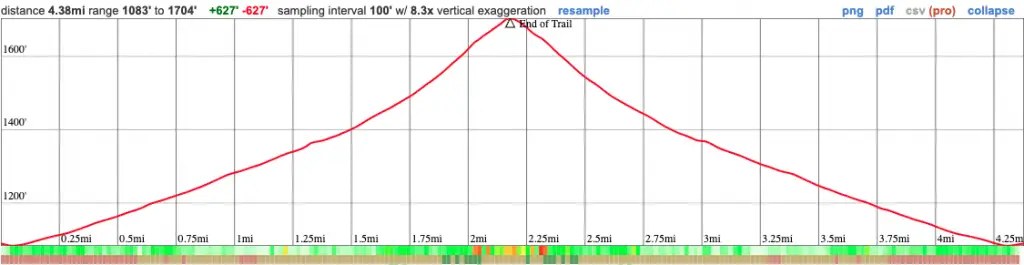
4.38 Miles

Time

2.5 Hrs

Difficulty 

Easy

Season

All Year

Elevation Gain

705 Ft

  • Dogs allowed on a leash
  • Out & Back Trail
  • Restrooms Not Available

Deep in the Corona woods, an abandoned mine lays waiting to be explored. Tell me this doesn’t get your heart pumping.

The Tin Mine Canyon Trail is a relatively flat and easy trek in Riverside County. Although the first half of the trail consists of either a dirt or paved road, the scenery drastically changes inside the canyon. Both mine portals are unfortunately closed. A long sleeved shirt and pants is highly recommended as poison oak is abundant inside the canyon.

For a complete list of hikes in Riverside County, check out the following link:

Riverside County Hikes

Tin Mine Canyon Trail Map

powered by Advanced iFrame

Download Printable PDF Map

Tin Mine Canyon Address & Directions

To be redirected to the trailhead via Google Maps, click the following link: Skyline Dr, Corona, CA 92882

Parking is available on W. Foothill Pkwy, but due to the entire area being popular, expect lots of people on the weekends.

Tin Mine Canyon Trail

The hike begins on a paved road called Skyline Drive that is shared by hikers and bikers, and runs adjacent to people’s houses.

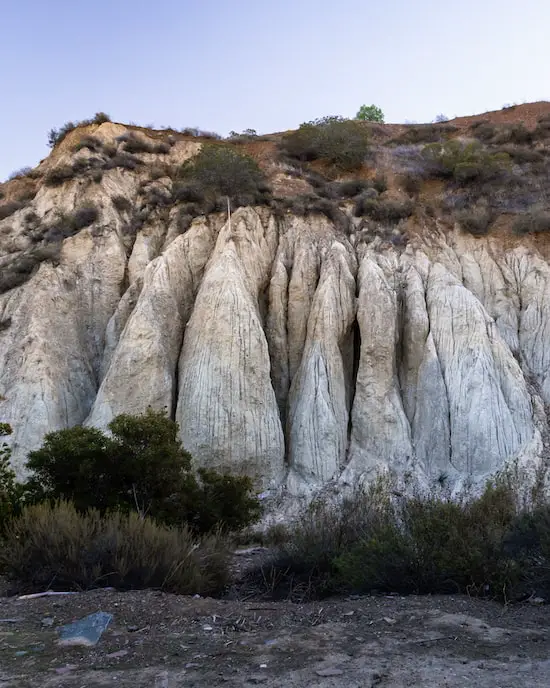
The start of the trek would have been rather dull if it wasn’t for the crazy looking sandstone formations shown below. The creek runs at the base of these formations.

Tin Mine Canyon Sandstone formations

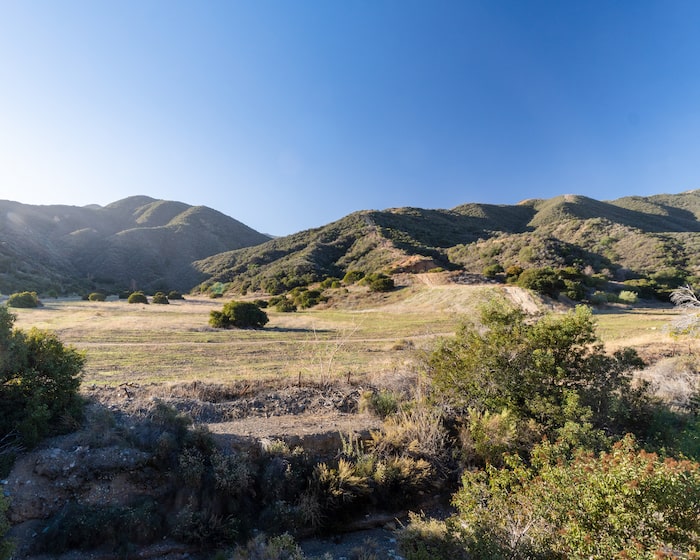
After the first bend the view opens up and a beautiful morning sun illuminates picturesque green pastures.

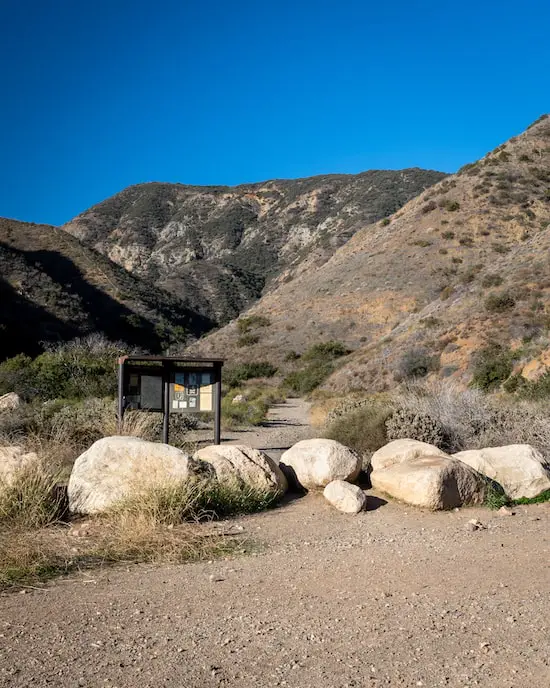
While most people head up the hill to the right, you’ll continue your trek by heading straight into the canyon.

This is where it gets good.

Read More: Two Trees Trail in Box Springs Mountain Regional Park

Before arriving at the main portal, there’s a concave dent on the left side of the canyon wall.

It seems like this used to be a shaft of some sort.

The primary mine looks like something out of a movie, with the wind violently blowing poison oak vines around the portal. There was no one else in the area.

Only darkness as far as the eye can see.

Read More: Mt Rubidoux Trail: Amazing 360 Panoramic Views

A bit further up the trail and to your left, you’ll see a second portal precariously located about 25 feet above the canyon floor.

Unfortunately, this one is also closed.

From this point forward the vegetation gets significantly dense, but also stunning. I felt like I was in the dense canyons of the San Gabriel Mts.

Poison oak is abundant, so long sleeves and pants are non-negotiable.

The trail abruptly ends, but the adventure doesn’t have to.

For those who enjoy a bit of rock scrambling, there are a series of small seasonal waterfalls further up the stream.

Had there been water, the creek would have been a real treat. Nevertheless, it’s a fun detour which only takes 10 minutes.

Read More: Pumpkin Rock: A Giant Halloween Boulder 

Bailey Canyon Nature Trail: Hike to a Locals Only Falls (Closed)

Bailey Canyon Nature Trail: Hike to a Locals Only Falls (Closed)

  • Miles: .9
  • Time: 30 min
  • Difficulty: Easy
  • Best Season: Mid-Late Spring
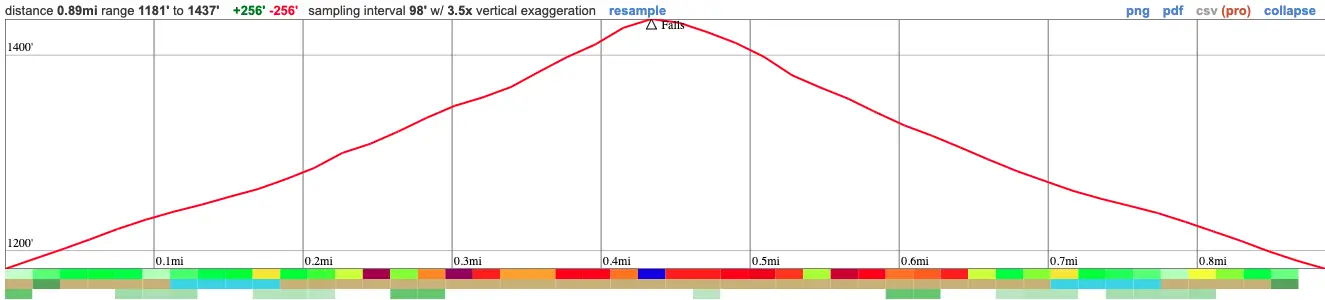
  • Elevation Gain: 256 ft
  • Max Elevation: 1437 ft
  • Type of Trail: Out & Back
  • Parking Lot: Fits ≈ 20 cars
  • Dogs: Allowed On A Leash
  • Restrooms: Available
  • Trail Popularity: Very Low
  • Pics Taken On: Sept 2, 2023

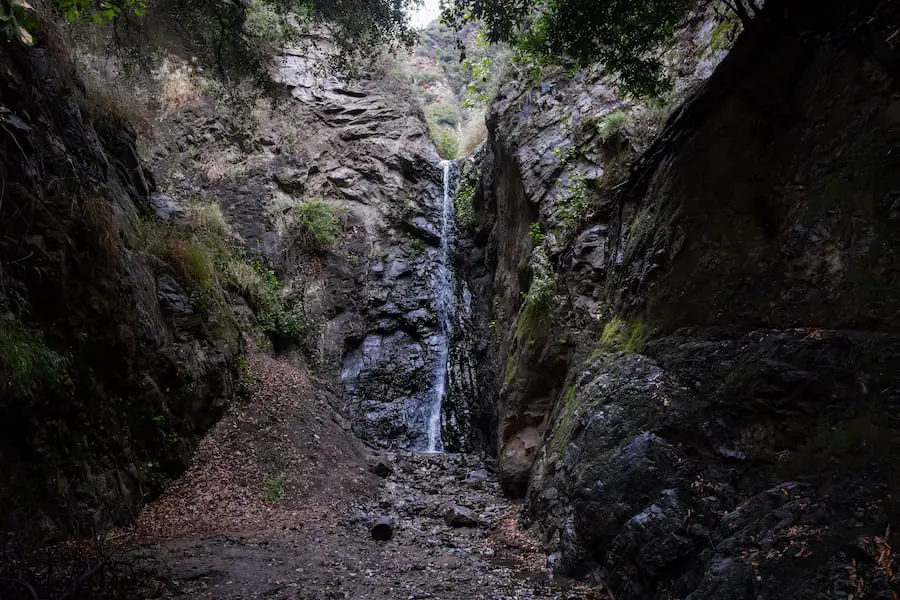
Bailey Canyon Nature Trail takes you to a rarely flowing waterfall which has been kept a secret by the locals for a very long time. However, if you pick the right day to visit, you might just see it flowing.

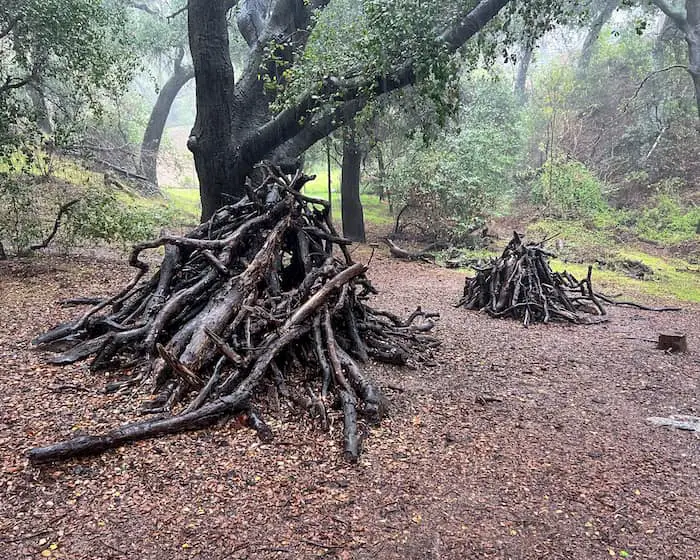
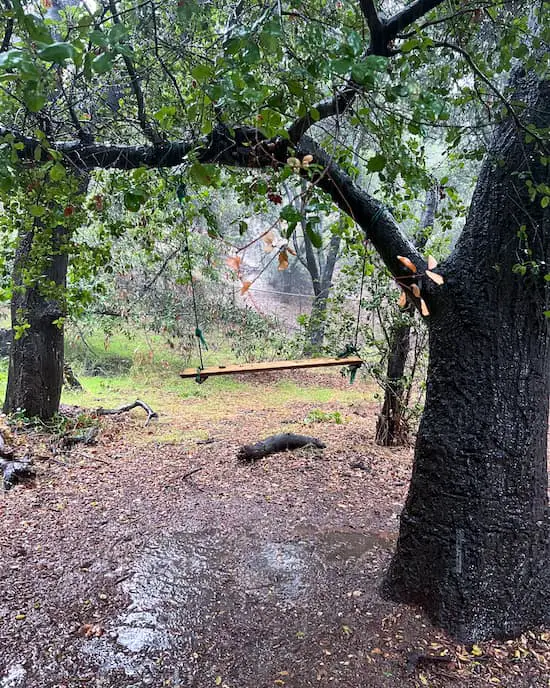
PLEASE READ: This waterfall is a gem to all the people who live nearby. There is no trash or graffiti, and there are many signs of little people playing in the area (children), such as the swing and branch teepees. Please, for their sake, keep the place between yourself and those who you know will respect the area. Thank you 🙂

How to See Bailey Canyon Falls When It’s Flowing

Bailey Canyon Falls is rarely flowing, even during spring. The only time there is water at the falls is the day it rains and the day immediately after.

However, I HIGHLY advice against visiting the area while it’s raining, as my buddy and I were nearly hit by rockslides during our visit, and two people have drowned during flash floods. Instead, I recommend visiting a day or two after it rains.

Bailey Canyon Nature Trail Map

powered by Advanced iFrame

Bailey Canyon Nature Trail Elevation Profile

Download Printable PDF Map

Bailey Canyon Nature Trail Directions

Click the link HERE to be redirected to the Bailey Canyon Nature Trail parking lot via Google Maps.

Bailey Canyon Nature Trail

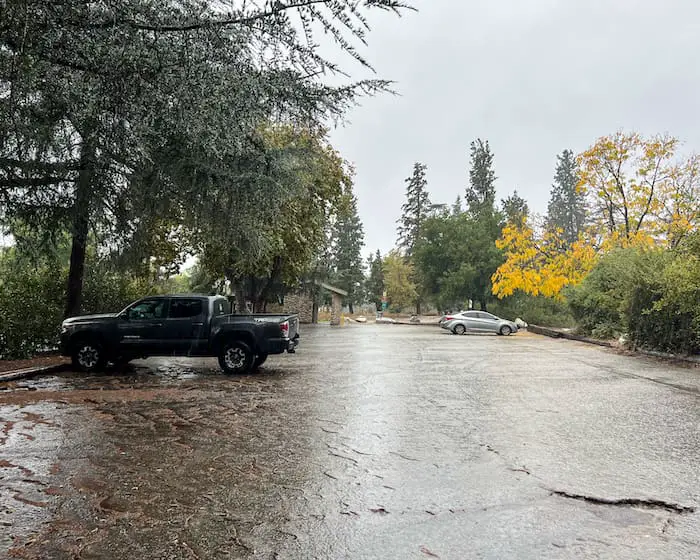
The nature trail begins in a little parking lot tucked into the foothills of the lovely town known as Sierra Madre.

bailey canyon nature trail parking lot

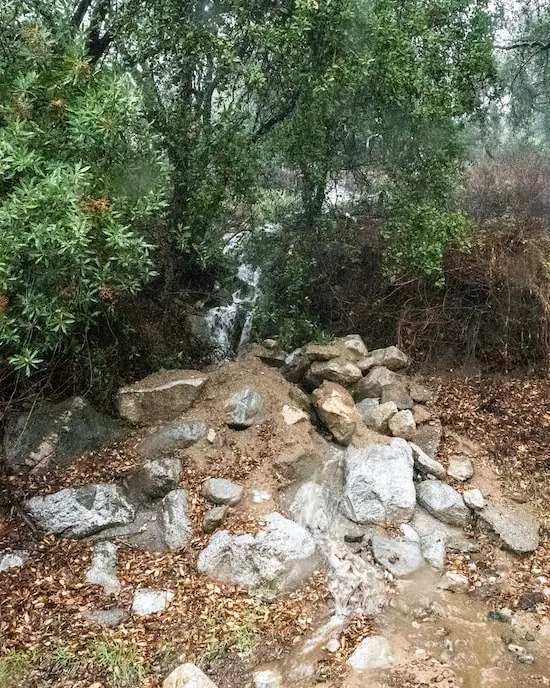
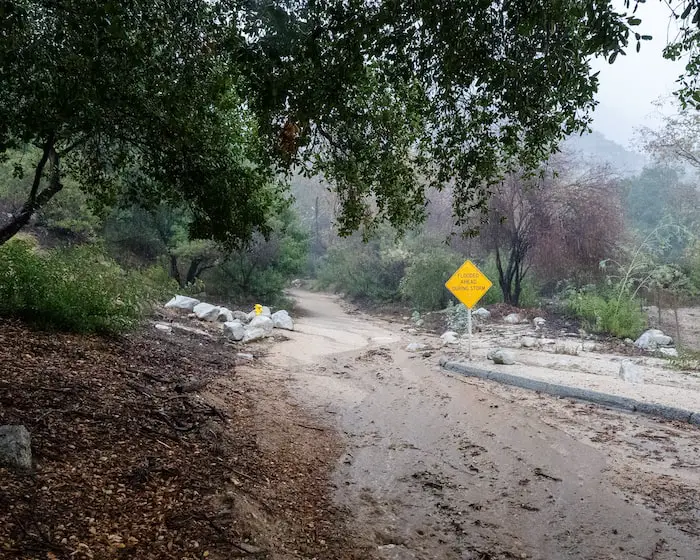
Since we visited while it was raining, the water was flowing directly into the parking lot, and the crystal clear droplets poured all around us from the tall pine trees.

Surprisingly, one of the houses which borders the road had a waterfall raging down about 15-20ft (if only Bailey Falls had the same flow).

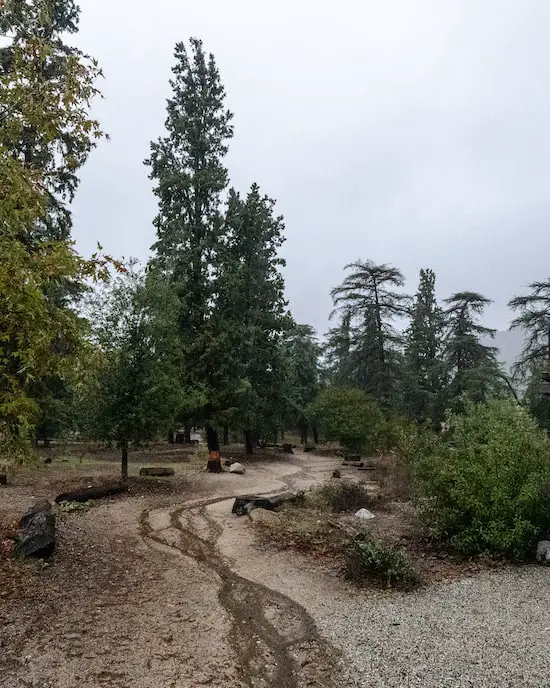
Although it wasn’t raining too hard, you can see from the picture below why flash floods can be a huge danger.

Detour

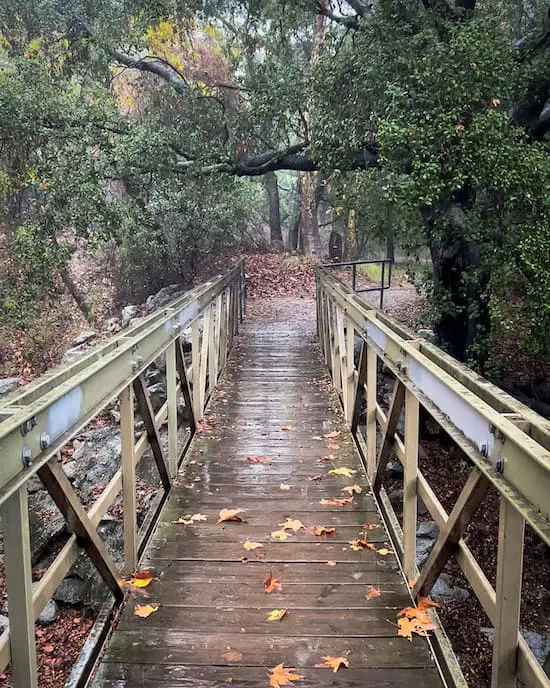
Right before entering the canyon, you’ll notice a bridge traversing the debris reservoir.

I didn’t add it on the the map as it’s a detour, but I highly recommend checking it out.

It leads to a little flats covered by the forest canopy, as well as a couple of shelters and a swing.

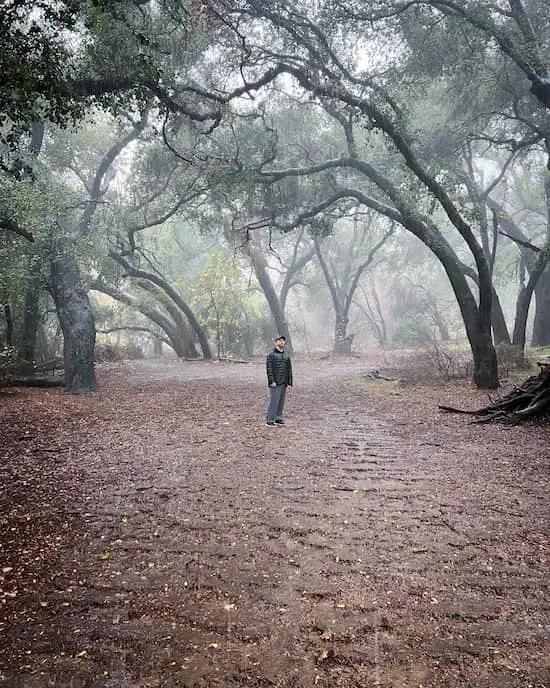
Notice the area (and all of Bailey Canyon Wilderness Park for that matter) is extremely well preserved. I didn’t see a single piece of trash anywhere on the ground.

Head back the way you came to return to the main route.

Detour Ends. Back on The Main Trail

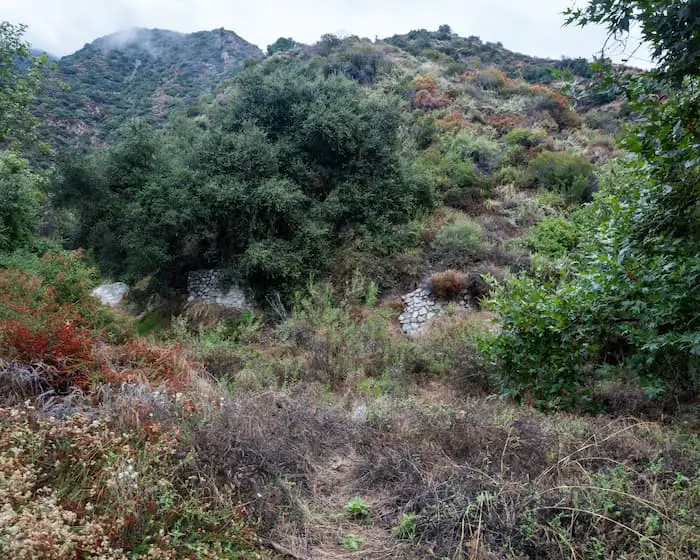
As I ventured into the canyon, the creek will be located to your right and below you. I spotted some ruins on the opposite side of the creek, but have yet to find any information on them.

Ruins at Bailey Canyon

I kept moving forward, wondering how flash floods could be so dangerous on this trail when the creek was a few feet below me.

My questions were answered within a few minutes when the trail descended to the same elevation as the creek.

By the way, the image below is the fork where you can head up to Jones Peak from Baily Canyon.

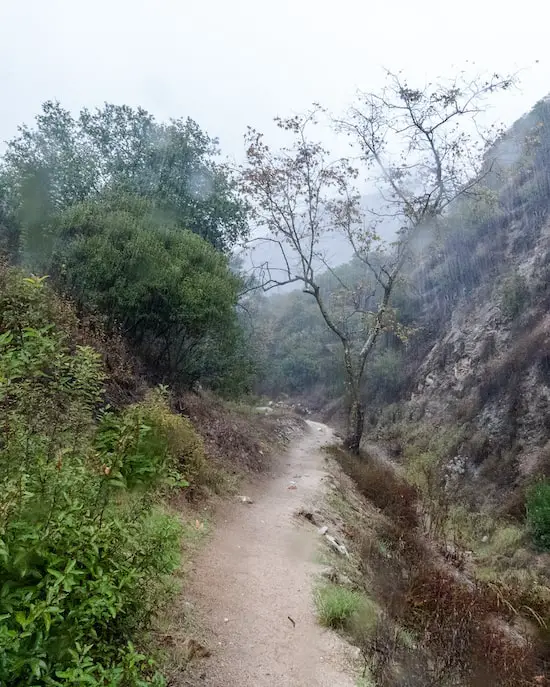
During my second visit, I noticed the beginning of the hike didn’t have running water in the creek, but about halfway, that quickly changed. There was a lot of creek crossing over slippery rocks involved.

There are some sections of the trail which are very overgrown, especially during the spring. Make sure not to accidentally make contact with poison oak.

I made a sharp right turn and came face to face with a beautiful 25 foot falls. While most waterfalls are roaring due to the wet winter we just had, Bailey Cn Falls was still barely more than a trickle.

Seeing it flow really is a especially occasion.

A second cascade is located to the left and resembles a curved playground slide. Unfortunately, it had even less water.

Bailey Canyon Falls measures roughly 25ft.